Refraction at a Spherical Surface
Imagine you are looking at a fish in a pond. The fish appears closer to the surface than it actually is. That is refraction — light bends when it moves from water into air. Now imagine the boundary between the two media is not flat, but curved like the surface of a lens or a glass marble. That is a spherical refracting surface.
The Intuition
When light hits a flat surface (like a glass slab), it bends once and travels straight. But when the surface is curved, something more interesting happens. Each ray of light strikes the curve at a slightly different angle, so each ray bends by a different amount. The result is that all rays leaving one point can be made to converge to (or diverge from) another point — forming an image.
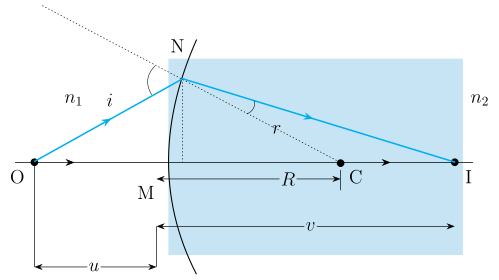
Think of a spherical surface as a tiny piece of a sphere. The centre of that sphere is called the centre of curvature C, and the distance from the surface to C is the radius of curvature R. The line joining the centre of curvature to the centre of the surface is the principal axis.
The Sign Convention
Before we write the formula, we need a consistent way to measure distances. The standard convention (Cartesian sign convention) is:
- Distances measured against the direction of incident light are negative.
- Distances measured along the direction of incident light are positive.
- The pole P (the vertex of the spherical surface) is the origin.
So for a convex surface (bulging toward the incident light), R is positive. For a concave surface (curving away), R is negative. Object distance u is always negative (object is on the incident side). Image distance v can be positive or negative depending on where the image forms.
The Derivation in One Paragraph
Consider a point object O on the principal axis. A ray from O strikes the spherical surface at point A and bends according to Snell's law: n1sini=n2sinr. For small angles (paraxial approximation), sinθ≈θ, so n1i=n2r. Using geometry, i=α+γ and r=γ−β, where α, β, γ are the angles the ray makes with the principal axis at O, I, and C respectively. Substituting and using α≈tanα=POAP, β≈PIAP, γ≈PCAP, and cancelling AP, you get the relation.
vn2−un1=Rn2−n1
Here:
- n1 = refractive index of the medium where the object lies
- n2 = refractive index of the medium where the image forms
- u = object distance from pole (negative)
- v = image distance from pole (positive if real image on the opposite side)
- R = radius of curvature (positive if centre of curvature is on the image side)
What This Formula Tells You
The formula is a single equation that connects four things: where the object is, where the image forms, how curved the surface is, and what the two media are. If you know any three, you can find the fourth.
For a convex surface (say, light going from air into glass through a convex surface), R>0 and n2>n1, so the right side is positive. This means v is positive — the image forms on the other side. The surface converges light.
For a concave surface (light going from air into glass through a concave surface), R<0, so the right side is negative. The surface diverges light. …