Question of 35
Q.Explain the principle of working of a heat engine with diagram. Define its efficiency.
Meghalaya MboseMBOSE Meghalaya 11th Board 2018Subjective· 3mImportance★★★★★
0% · 0/35 Questions
You're viewing a preview — the full solution, concept, methods & PYQ mapping are locked.
Start your 14-day free trial to unlock the full solution →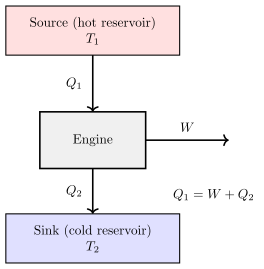
A heat engine absorbs heat Q1 from a hot source, converts part of it into work W, and rejects the rest, Q2, to a cold sink, returning to its original state every cycle; its efficiency is eta = W/Q1 = 1 - Q2/Q1.
Working principle: A heat engine consists of three essential parts:
- A hot reservoir (source) at temperature T1, which supplies heat.
- A working substance (e.g. gas in a cylinder-piston arrangement), which undergoes a cyclic process.
- A cold reservoir (sink) at temperature T2 (T2 < T1), which absorbs the rejected heat.
In each cycle, the working substance:
- absorbs an amount of heat Q1 from the source,
- does an amount of external work W (e.g. by pushing a piston),
- rejects a remaining amount of heat Q2 to the sink,
- and returns to its initial state (since it works in a CYCLE, its internal energy change over one full cycle is zero). …
Unlock everything free for 14 days
- Full step-by-step solutions
- Concept-first explanations
- Methods, shortcuts & mistakes
- PYQ mapping + timed mock tests
Full access for 14 days. No credit card required.