Question of 90
Q.Describe the process of fertilization in angiospermic plants. Give suitable diagram.
Meghalaya MboseMBOSE Meghalaya Intermediate Board 2021Subjective· 3mImportance★★★★★
0% · 0/90 Questions
You're viewing a preview — the full solution, concept, methods & PYQ mapping are locked.
Start your 14-day free trial to unlock the full solution →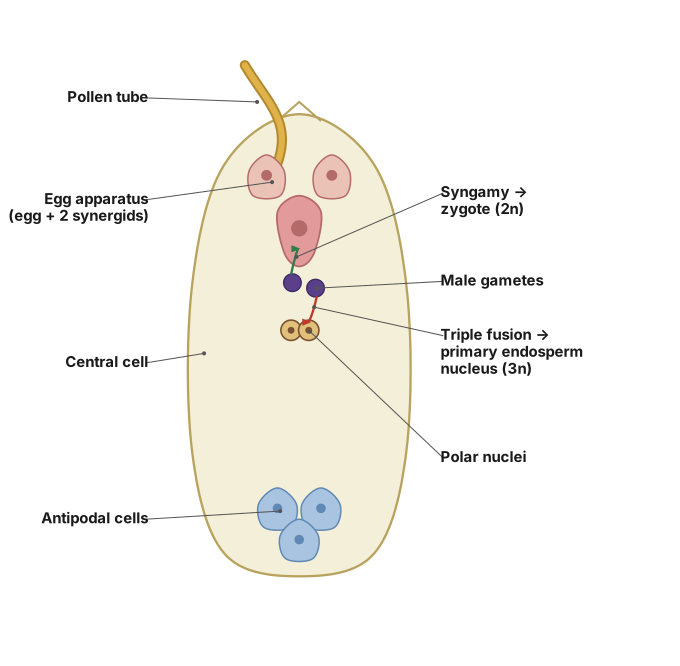
After pollination, the pollen tube carries two non-motile male gametes into the embryo sac, where one fuses with the egg (syngamy → zygote) and the other fuses with the two polar nuclei (triple fusion → endosperm), together called double fertilization — unique to angiosperms.
Process of fertilization in angiospermic plants
- Pollen germination and tube growth: After pollination (transfer of pollen to the stigma), a compatible pollen grain absorbs nutrients from the stigma and germinates, putting out a pollen tube through a germ pore. The vegetative (tube) cell's cytoplasm, along with the two male gametes carried by the generative cell (which divides into two male gametes before or during pollen tube growth), moves down through the tube.
- Path of the pollen tube: The pollen tube grows through the tissue of the stigma and style and enters the ovule. It most commonly enters through the micropyle (porogamy — the most common pathway); it may occasionally enter through the chalaza (chalazogamy) or integument (mesogamy).
- Entry into the embryo sac: After reaching the ovule, the pollen tube enters one of the synergids through the filiform apparatus, and releases the two male gametes into the cytoplasm of the synergid.
- Double fertilization — the pollen tube discharge leads to two fusion events occurring inside the embryo sac:
- Syngamy: one male gamete (n) fuses with the egg cell / oosphere (n) to form the diploid (2n) zygote, which subsequently develops into the embryo.
- Triple fusion: the second male gamete (n) fuses with the two polar nuclei (or the secondary nucleus formed by their fusion, each n) present in the central cell, forming the triploid (3n) primary endosperm nucleus (PEN).
Since two separate fusion events (syngamy and triple fusion) occur together within the same embryo sac, this phenomenon is termed double fertilization, a unique and defining feature of flowering plants (angiosperms), first described by Nawaschin.
…
Unlock everything free for 14 days
- Full step-by-step solutions
- Concept-first explanations
- Methods, shortcuts & mistakes
- PYQ mapping + timed mock tests
Full access for 14 days. No credit card required.