Q.Discuss the role of Lewis acids in the preparation of aryl bromides and chlorides in the dark.
You're viewing a preview — the full solution, concept, methods & PYQ mapping are locked.
Start your 14-day free trial to unlock the full solution →Aryl bromides and chlorides are prepared from benzene using bromine or chlorine in the dark, but only in the presence of a Lewis acid catalyst (like FeBr₃ or AlCl₃) which polarises the halogen molecule, enabling electrophilic aromatic substitution. The final product is a mono-halogenated arene (e.g., bromobenzene or chlorobenzene).
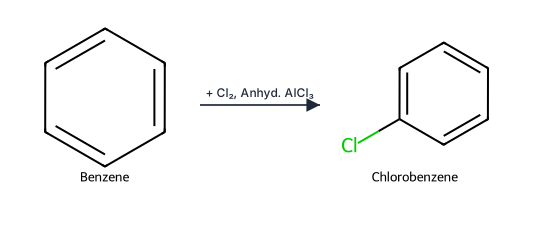
The direct halogenation of benzene with Br₂ or Cl₂ does not occur in the dark — or even in diffuse light — because benzene’s delocalised π-electron cloud is too stable to act as a nucleophile toward a non-polarised halogen molecule. The key is to generate a stronger electrophile. This is where a Lewis acid comes in.
A Lewis acid is an electron-pair acceptor. When you add FeBr₃ (or AlCl₃) to bromine, the iron atom accepts a lone pair from bromine, polarising the Br–Br bond heavily. The result is a complex that behaves as if it were “Br⁺” — a powerful electrophile that can attack benzene’s π-system.
Let’s walk through the mechanism step by step.
- Generation of the electrophile The Lewis acid (say FeBr₃) coordinates with one bromine atom of Br₂. This pulls electron density away from the Br–Br bond, making the far bromine strongly electron-deficient.
In effect, we get a complex that can be thought of as (the electrophile) paired with a counterion.
- Electrophilic attack on benzene The π-electron cloud of benzene donates two electrons to the electrophilic bromine. This forms a sigma bond between bromine and one carbon of the ring, breaking the aromaticity and creating a resonance-stabilised carbocation intermediate (the arenium ion or σ-complex).
- Restoration of aromaticity The arenium ion is unstable. It loses a proton (H⁺) from the carbon that attacked bromine. The pair of electrons from the C–H bond moves back into the ring, restoring the aromatic sextet. The H⁺ then combines with the to reform FeBr₃ and HBr. …
Unlock everything free for 14 days
- Full step-by-step solutions
- Concept-first explanations
- Methods, shortcuts & mistakes
- PYQ mapping + timed mock tests
Full access for 14 days. No credit card required.