Q.Toluene reacts with a halogen in the presence of iron (III) chloride giving ortho and para halo compounds. The reaction is
You're viewing a preview — the full solution, concept, methods & PYQ mapping are locked.
Start your 14-day free trial to unlock the full solution →Toluene undergoes electrophilic aromatic substitution with a halogen in the presence of FeCl₃. The halogen is activated by FeCl₃ to form an electrophile, which attacks the electron-rich benzene ring. The correct option is (ii).
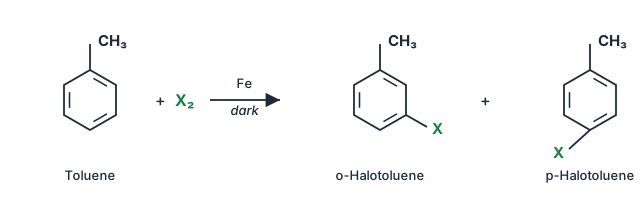
The key here is to recognise what kind of reagent a halogen becomes when mixed with a Lewis acid like FeCl₃. On its own, Cl₂ or Br₂ is not strongly electrophilic — it needs a "push" to become reactive toward an aromatic ring. FeCl₃ does exactly that: it polarises the halogen molecule, making one end strongly positive (the electrophile). This is a classic setup for electrophilic aromatic substitution, not addition or free-radical chemistry.
Let’s walk through the reasoning step by step.
-
Identify the reaction type from the reagents.
Toluene (methylbenzene) is an aromatic compound. Halogens (Cl₂, Br₂) do not normally add to aromatic rings under these conditions — they substitute. The presence of FeCl₃ (a Lewis acid) is a dead giveaway: it’s the catalyst used in the halogenation of aromatic rings. This is not a free-radical or nucleophilic process.
-
Understand the role of FeCl₃.
FeCl₃ coordinates with the halogen, say Cl₂, forming a complex like FeCl₄⁻ and Cl⁺ (or a highly polarised Cl–Cl bond). This generates a strong electrophile — a chlorine atom with a partial or full positive charge.
-
Why electrophilic substitution, not addition?
The aromatic ring is rich in π electrons. It attacks the electrophile (Cl⁺) to form a carbocation intermediate (the arenium ion). If addition occurred, the aromaticity would be permanently lost — but here, the intermediate loses a proton (H⁺) to restore the aromatic ring. That’s the hallmark of substitution: one H is replaced by Cl, and the ring remains aromatic.
-
Why ortho/para products?
Toluene has a methyl group, which is an activating, ortho/para-directing group. It donates electron density into the ring (hyperconjugation + inductive effect), making the ortho and para positions more nucleophilic. So the incoming halogen preferentially attacks those positions, giving a mixture of ortho- and para-halotoluene.
-
Eliminate the wrong options. …
Unlock everything free for 14 days
- Full step-by-step solutions
- Concept-first explanations
- Methods, shortcuts & mistakes
- PYQ mapping + timed mock tests
Full access for 14 days. No credit card required.