Q.(a) Why do transition metals generally form coloured compounds? (1 mark)
You're viewing a preview — the full solution, concept, methods & PYQ mapping are locked.
Start your 14-day free trial to unlock the full solution →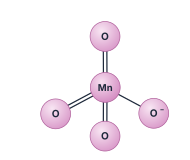
Transition-metal colour arises from d-d transitions; permanganate is tetrahedral ; / redox behaviour follows from which configuration ( or ) is more stable; and dichromate's oxidations of and are balanced. (Or: alloying, the Ag-vs-Zn transition-metal distinction, and 's balanced reaction with oxalic acid and its industrial preparation from pyrolusite are covered.)
(a) Why transition metals form coloured compounds
Most transition-metal ions have partially filled -orbitals. In a complex, the surrounding ligands split the five degenerate -orbitals into two sets of different energy (crystal-field splitting, e.g. and in an octahedral field). An electron can absorb a photon of visible light and jump from the lower-energy -orbital set to the higher one (a d–d transition). Since only specific wavelengths of visible light are absorbed for this transition, the transmitted/reflected light — the complementary colour — is what we see as the colour of the compound. (Ions with an empty, , or completely filled, , configuration have no such transition available and are usually colourless/white, e.g. , .)
(b) Structure of the permanganate ion,
is tetrahedral: manganese (oxidation state +7) sits at the centre with four oxygen atoms at the corners of a tetrahedron. All four Mn–O bonds are equivalent in length and bond order, due to resonance/delocalisation of -electron density over all four Mn–O bonds (– overlap between filled O -orbitals and empty Mn -orbitals), giving each bond partial double-bond character.
(c) Why is reducing and is oxidising (both genuinely — note itself is , so this compares and , the standard pair with this property)
- () is easily oxidised to (), because corresponds to the extra-stable half-filled configuration in an octahedral field. Losing an electron to reach this stable arrangement is energetically favourable, so readily donates an electron — it is a good reducing agent.
- () is easily reduced to (), because is the extra-stable half-filled configuration (all five -orbitals singly occupied, maximum exchange energy). Gaining an electron to reach this stable arrangement is energetically favourable, so readily accepts an electron — it is a good oxidising agent.
(d) Reactions of in acidic medium
- With KI (dichromate oxidises iodide to iodine):
- With (dichromate oxidises sulfide to sulfur): In both, orange is reduced to green . …
Unlock everything free for 14 days
- Full step-by-step solutions
- Concept-first explanations
- Methods, shortcuts & mistakes
- PYQ mapping + timed mock tests
Full access for 14 days. No credit card required.