Q.What is propensity to save ? Distinguish between APS and MPS. (2+1+1=4)
🔒You're viewing a preview — the full solution, concept, methods & PYQ mapping are locked.
🔒 Start your 14-day free trial to unlock the full solution →Concept understanding — Marginal Propensity to Consume
Marginal Propensity to Consume (MPC)
Start with everyday intuition
Think about what happens when you get some extra money — say, a ₹500 bonus from your part-time job, or a cash gift on your birthday. You don't save all of it, and you don't spend all of it either. Most people spend a part and save the rest. That part you spend — the fraction of the extra income that goes into consumption — is exactly what economists call the Marginal Propensity to Consume.
The word "marginal" here means "extra" or "additional." So MPC answers one simple question: Out of every extra rupee you earn, how much do you spend?
The precise meaning
Formally, MPC is the ratio of change in consumption expenditure to the change in income that brought it about.
MPC=ΔYΔC
where ΔC = change in consumption, ΔY = change in income.
For example, if your income rises by ₹1,000 and your consumption rises by ₹750, your MPC is 750/1000=0.75 (or 75%). This means you spend 75 paise of every extra rupee and save the remaining 25 paise.
The other side of the coin is the Marginal Propensity to Save (MPS) — the fraction of extra income that is saved. Since every extra rupee is either spent or saved:
MPC+MPS=1
This is not a theory; it's an accounting identity. If MPC = 0.75, then MPS must be 0.25.
Why MPC matters
MPC is not just a number — it is the engine of the multiplier effect, one of the most powerful ideas in macroeconomics.
When someone spends money, that spending becomes someone else's income. That second person, in turn, spends a fraction (their MPC) of that income, which becomes a third person's income, and so on. A single initial injection of spending — say, government investment in a road — ripples through the economy, generating total income many times larger than the original spending.
The size of this ripple depends directly on MPC. The higher the MPC, the larger the multiplier.
Multiplier (k)=1−MPC1=MPS1
If MPC = 0.8, the multiplier is 1/(1−0.8)=5. An initial ₹100 crore investment can generate ₹500 crore of total income. If MPC = 0.5, the multiplier is only 2.
A word on the diagram …
Propensity to save describes how households split additional income between saving and spending as their income changes. …
APS looks at the share of total income saved; MPS looks at the share of an extra rupee of income that gets saved.
Propensity to save (1 mark): This refers to the psychological/behavioural tendency of households to save a part of their income rather than spend all of it, and how this saving behaviour changes as income rises.
Average Propensity to Save, APS (1 mark): APS = Total Savings (S) ÷ Total Income (Y). It measures the proportion of total income that is saved, and can be zero, positive or even negative (if a household dis-saves by spending more than its income).
Marginal Propensity to Save, MPS (1 mark): MPS = Change in Savings (ΔS) ÷ Change in Income (ΔY). It measures how much of an additional rupee of income is saved, and normally lies between 0 and 1.
…
Showing the 12 most recent of 104 on this concept.
- CBSE 2026Set 58/1/11 markMCQQ.Identify, which of the following is true at the Break Even level of Income. (Choose the correct option) Options : (A) Slope of Consumption Curve = Slope of Saving Curve (B) Average Propensity to Consume (APC) = Average Propensity to Save (APS) (C) Slope of Saving Curve = Unity(1) (D) Average Propensity to Consume (APC) = Unity (1)
›Reveal solutionSolution
At break-even income, consumption exactly equals income (saving is zero), which means the entire income is consumed — so APC = 1.
The break-even point in consumption theory is the level of income at which a household or economy consumes exactly what it earns. There is no saving and no dissaving; the consumption function intersects the 45° line (where C=Y).
To see which statement holds at this point, recall what break-even means algebraically. If income is Y and consumption is C, then at break-even:
C=Y
Since saving S=Y−C, we have:
S=Y−Y=0
Now examine each option in turn.
Option (A): Slope of Consumption Curve = Slope of Saving Curve
The slope of the consumption curve is the marginal propensity to consume, MPC=dYdC. The slope of the saving curve is the marginal propensity to save, MPS=dYdS. We know that MPC+MPS=1 always (since any additional rupee of income is either consumed or saved), so MPC=MPS would require both to equal 0.5. This is not a general property of the break-even point — it depends on the specific consumption function. The break-even condition tells us nothing about the slopes.
Option (B): Average Propensity to Consume (APC) = Average Propensity to Save (APS)
The average propensity to consume is APC=YC and the average propensity to save is APS=YS. At break-even, C=Y and S=0, so:
APC=YY=1,APS=Y0=0
These are not equal.
Option (C): Slope of Saving Curve = Unity (1) …
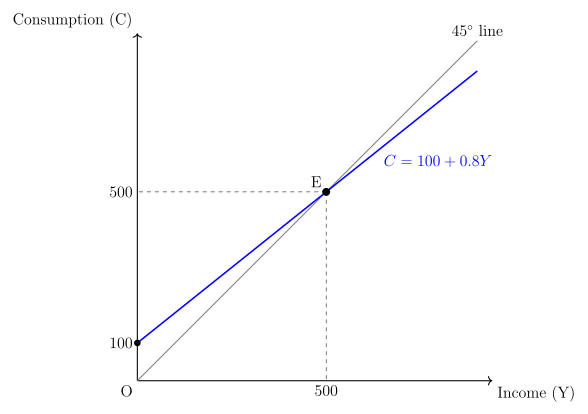
- CBSE 2026Set 58/2/11 markMCQQ.Choose the correct consumption function from the options given below with reference to the illustrated given diagram. (Diagram: X-axis = Income, Y-axis = Consumption; a 45° Income Line; a consumption curve C with a positive intercept of 100; equilibrium point E where the C curve cuts the 45° line; dashed lines mark C = 280 at one income level and C = 700 at income = 800.) Options : (A) C = 100 + 0.7Y (B) C = 100 + 0.8Y (C) C = 100 – 0.7Y (D) C = 100 – 0.8Y
›Reveal solutionSolution
The consumption curve has autonomous consumption Cˉ=100 (its vertical intercept) and its slope is the MPC. Using the break-even point E where the curve cuts the 45° line (C=Y=500), the MPC works out to exactly 0.8, so the consumption function is C=100+0.8Y — option (B).
The consumption function and its components
A consumption function describes the relationship between national income Y and aggregate consumption C. The standard Keynesian form is
C=Cˉ+cY
where Cˉ is autonomous consumption (consumption when income is zero — the vertical intercept) and c is the marginal propensity to consume (MPC), the fraction of each additional rupee of income spent on consumption, and geometrically the slope of the line.
The diagram gives us two facts. First, the consumption curve has a positive vertical intercept of 100, so Cˉ=100. Second, the curve is upward-sloping, which immediately rules out options (C) and (D): a negative coefficient would mean consumption falls as income rises, contradicting both theory and the diagram.
Finding the MPC from the break-even point
The cleanest way to read the slope off this diagram is the break-even point E, where the consumption curve intersects the 45° line. Along the 45° line every point satisfies C=Y, so at E consumption exactly equals income. From the diagram, this occurs at Y=C=500.
Substituting Cˉ=100 and the point (Y,C)=(500,500) into C=Cˉ+cY:
500=100+c(500)
400=500c
c=500400=0.8 …
- CBSE 2026Set 58/2/11 markMCQQ.The Aggregate Demand (AD) curve lies parallel to consumption curve, indicating that both have ________. (Choose the correct option to fill in the blank) (A) same components (B) different slope (C) same slope (D) inverse relationship
›Reveal solutionSolution
The Aggregate Demand (AD) curve is derived by vertically shifting the consumption curve upwards by the amount of autonomous expenditures; since these additions are independent of income, the slope of the AD curve remains the same as the slope of the consumption curve, which is the Marginal Propensity to Consume (MPC).
To understand why the Aggregate Demand (AD) curve lies parallel to the consumption curve, we need to examine the components and slopes of both.
First, let's consider the consumption function. In Keynesian economics, the consumption function describes the relationship between consumption expenditure and disposable income. It is typically represented as:
C=Cˉ+bY
where:
- C is total consumption expenditure.
- Cˉ is autonomous consumption (consumption that occurs even when income is zero).
- b is the Marginal Propensity to Consume (MPC), which is the change in consumption for a unit change in income (ΔC/ΔY).
- Y is disposable income.
The slope of the consumption curve is given by b, the Marginal Propensity to Consume. This value indicates how much of an additional rupee of income is spent on consumption.
Next, let's look at the Aggregate Demand (AD) function. Aggregate Demand represents the total demand for goods and services in an economy at a given price level. In a simple two-sector economy (households and firms), AD is the sum of consumption (C) and investment (I):
AD=C+I
Substituting the consumption function into the AD equation:
AD=(Cˉ+bY)+I
In this simplified model, investment (I) is often assumed to be autonomous, meaning it does not depend on the level of income. It is determined by factors like interest rates, business expectations, and government policy. Therefore, I is a constant value.
We can rearrange the AD function as:
AD=(Cˉ+I)+bY
The Aggregate Demand function in a simple two-sector economy is given by:
AD=(Cˉ+I)+bY …
- CBSE 2026Set 58/3/11 markMCQQ.Select the correct formula to calculate the value of Marginal Propensity to Save (MPS) : I. Change in Savings (ΔS) / Change in Consumption (ΔC) II. Change in Savings (ΔS) / Change in Income (ΔY) III. 1 – Marginal Propensity to Consume (MPC) IV. Change in Income (ΔY) / Change in Savings (ΔS) Options : (A) I, II, III and IV (B) II and III (C) Only III (D) Only II
›Reveal solutionSolution
MPS measures the fraction of additional income that households save rather than consume. The correct formulas are II (ΔS/ΔY, the definition) and III (1 – MPC, from the income identity), so the answer is (B).
The Marginal Propensity to Save captures a simple behavioral question: when your income rises by one rupee, how much of that extra rupee do you tuck away as savings? It's the savings counterpart to the Marginal Propensity to Consume.
Start with the fundamental income identity. Every rupee of additional income must be either consumed or saved—there is no third bucket. Mathematically, for any change in income:
ΔY=ΔC+ΔS
Divide both sides by ΔY:
ΔYΔY=ΔYΔC+ΔYΔS
1=MPC+MPS
This tells us immediately that MPS = 1 – MPC (option III is correct). If households consume 0.75 of each additional rupee, they must save the remaining 0.25; the two propensities are complementary fractions of the same whole.
MPS=ΔYΔS=1−MPC
Now examine the definition. MPS is the responsiveness of savings to income, so by definition it is the ratio of the change in savings to the change in income that caused it: ΔS/ΔY (option II is correct). This is the direct, textbook definition—just as MPC is ΔC/ΔY, MPS is ΔS/ΔY. …
- CBSE 2026Set 58/3/11 markMCQQ.Read the following statements carefully : Statement I : At the break-even level of income, the value of slope of the consumption curve is zero. Statement II : Marginal Propensity to Consume (MPC) refers to the change in consumption per unit change in income. In the light of the given statements, choose the correct option from the following : (A) Statement I is true and Statement II is false. (B) Statement I is false and Statement II is true. (C) Both Statements I and II are true. (D) Both Statements I and II are false.
›Reveal solutionSolution
Statement I is false because the slope of the consumption curve at break-even income is the MPC, which is positive (not zero). Statement II is true because MPC is defined as the change in consumption per unit change in income.
Let’s unpack this carefully. The question tests two distinct ideas from the theory of consumption and income determination — the break-even point and the meaning of Marginal Propensity to Consume (MPC).
Statement I talks about the break-even level of income. In macroeconomics, the break-even point is that level of income where consumption exactly equals income — so saving is zero. At this point, the consumption curve (which plots consumption against income) is not flat; it has a positive slope. Why? Because the consumption function is typically written as C=Cˉ+bY, where Cˉ is autonomous consumption (positive even at zero income) and b is the MPC — the slope of the curve. At break-even, C=Y, so Cˉ+bY=Y, which gives Y=Cˉ/(1−b). The slope here is still b, which is a positive fraction (between 0 and 1). It is never zero unless MPC is zero, which would mean consumption never changes with income — a situation that contradicts the basic Keynesian consumption function. So Statement I is false.
NoteA common confusion: students sometimes think “break-even” means the curve is horizontal. But break-even is about the level of income where C = Y, not about the slope. The slope remains the MPC throughout. …
- CBSE 2026Set MARCH1 markMCQQ.Rate of change in savings as income increases is(a) Average propensity to consume(b) Average propensity to save(c) Marginal propensity to save(d) Marginal propensity to consume
›Reveal solutionSolution
The rate of change in saving as income changes is the marginal propensity to save, so the answer is (c).
…
- CBSE 2026Set ANNUAL1 markMCQQ.The consumer does not change his consumption despite change in his income, than the value of MPC will be A) MPC > 1 B) MPC = 1 C) MPC = 0 D) MPC < 1
›Reveal solutionSolution
No change in consumption when income changes means MPC = 0, so the answer is C.
Marginal Propensity to Consume (MPC) = change in consumption (ΔC) ÷ change in income (ΔY). The question states the consumer does not change consumption despite a change in income, so ΔC = 0. Therefore MPC = 0 ÷ ΔY = 0. Values like MPC > …
- CBSE 2026Set ANNUAL1 markMCQQ.Formula of consumption function is A) C = C̄ − cY B) C = C̄ + cY C) C = S̄ − cY D) C = S̄ + cY
›Reveal solutionSolution
The consumption function is C = C̄ + cY, so the answer is B.
In the Keynesian consumption function, C̄ is autonomous consumption (the consumption that takes place even at zero income) and c is the marginal propensity to consume, so cY is the induced consumption that rises with income Y. Consumption therefore increases with incom …
- CBSE 2026Set ANNUAL1 markQ.Define the average propensity to consume.
›Reveal solutionSolution
APC is total consumption divided by total income: APC = C/Y.
The Average Propensity to Consume (APC) measures the proportion of total income that households spend on consumption. It is defined as APC = C ÷ Y, where C is total consumption expenditure and Y is total (disposable) income. For example, if income is ₹1,000 and consumption is ₹800, then APC = 800 ÷ 1,000 = 0.8, meaning 80% of income is consumed. This is a standard definition in the Class-12 …
- CBSE 2026Set ANNUAL1 markQ.Find the value of MPS, if the MPC = 0.75.
›Reveal solutionSolution
MPS = 1 − MPC = 1 − 0.75 = 0.25.
Any additional unit of income is either consumed or saved, so the marginal propensity to consume (MPC) and the marginal propensity to save (MPS) always add up to 1: MPC + MPS = 1. Given MPC = 0.75:
| Step | Working |
|---|---| …
- CBSE 2026Set ANNUAL1 markMCQQ.The consumption function curve is(a) Upward sloping(b) Downward sloping(c) Parallel to the x-axis(d) Parallel to the y-axis
›Reveal solutionSolution
The consumption function curve is upward sloping, so the answer is (a).
The consumption function (C = a + bY) shows that as income (Y) increases, consumption (C) also increases, because the Marginal Propensity to Consume (the slope b) is positive. When consumption is plotted on the vertical axis against income on the horizontal axis, the curve there …
- CBSE 2026Set ANNUAL1 markQ.Write the answer in one sentence: What is marginal propensity to save?
›Reveal solutionSolution
MPS = ΔS / ΔY — the fraction of additional income that is saved.
The marginal propensity to save (MPS) is the ratio of the change in saving to the change in income: MPS = ΔS / ΔY. It shows the part of an additional unit of income that is saved. Its value lies between 0 and 1, and since extra income is either consumed or saved, MPS = 1 − …
🎓Unlock everything free for 14 days
- ✓Full step-by-step solutions
- ✓Concept-first explanations
- ✓Methods, shortcuts & mistakes
- ✓PYQ mapping + timed mock tests
Full access for 14 days. No credit card required.