Q.Define population. Illustrate different phases of growth in logistic growth curve or sigmoid growth curve depending on the environmental resistance. OR What is deforestation? Write any four causes of deforestation. Also write any four effects of deforestation.
You're viewing a preview — the full solution, concept, methods & PYQ mapping are locked.
Start your 14-day free trial to unlock the full solution →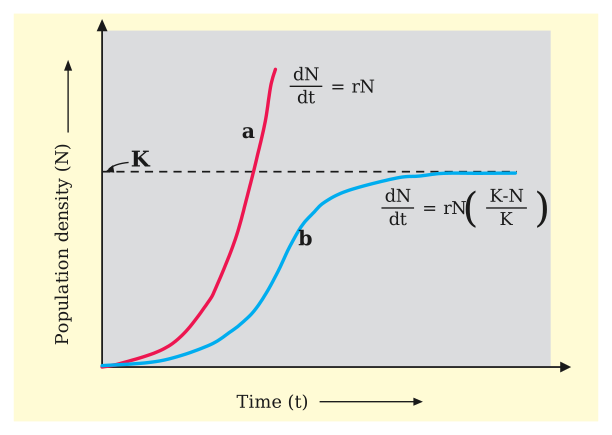
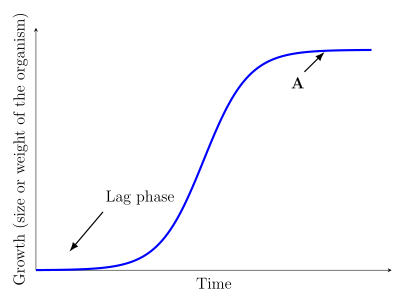
A population is an interbreeding group of one species sharing an area; under limited resources it grows in a characteristic S-shaped (logistic/sigmoid) curve — lag, exponential, deceleration, and stationary phases — levelling off at the environment's carrying capacity K.
Population: A group of individuals of the same species, living in a defined geographical area at the same time, capable of interbreeding, and sharing/competing for the same resources.
Logistic (sigmoid) growth curve: When resources (food, space) are limited (as is realistic in nature), population growth cannot continue exponentially forever — it is checked by environmental resistance, producing a characteristic S-shaped or sigmoid curve, described by the equation dN/dt = rN(K − N)/K, where N is population size, r is the intrinsic growth rate, and K is the carrying capacity (the maximum population size the environment can sustain).
Phases of the logistic growth curve:
- Lag phase: Initial phase with very few individuals; growth is slow as the population adjusts/establishes itself in the environment.
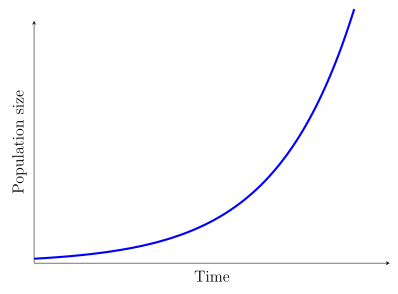
- Exponential (log) phase: As individuals reproduce with resources still abundant, the population grows rapidly, roughly doubling over regular intervals — the steepest part of the curve. …
Unlock everything free for 14 days
- Full step-by-step solutions
- Concept-first explanations
- Methods, shortcuts & mistakes
- PYQ mapping + timed mock tests
Full access for 14 days. No credit card required.