Q.With a labelled circuit diagram, explain the action of transistor as an oscillator. (1+2=3)
You're viewing a preview — the full solution, concept, methods & PYQ mapping are locked.
Start your 14-day free trial to unlock the full solution →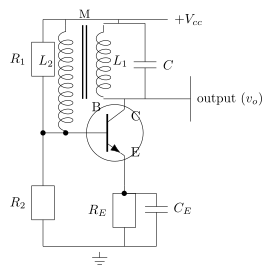
An oscillator is an amplifier that feeds a fraction of its own output back to its input in phase, so it sustains its own oscillation without an external AC input.
Circuit description (tuned-collector/LC oscillator): An NPN transistor is used in CE configuration. The collector circuit contains a parallel LC tank circuit (inductor in parallel with capacitor ), which sets the oscillation frequency. A second coil (feedback/tickler coil), inductively coupled to , is connected in the base circuit to feed a fraction of the output signal back to the base with the correct phase. Biasing resistors set the transistor's operating point, and a battery supplies power.
Working principle:
- When the circuit is switched on, a small transient current in the LC tank circuit sets up damped oscillations at the tank's natural (resonant) frequency .
- This oscillating voltage across the tank circuit is amplified by the transistor. …
Unlock everything free for 14 days
- Full step-by-step solutions
- Concept-first explanations
- Methods, shortcuts & mistakes
- PYQ mapping + timed mock tests
Full access for 14 days. No credit card required.