Q.Explain the elementary idea of an oscillator with the help of a block diagram.
You're viewing a preview — the full solution, concept, methods & PYQ mapping are locked.
Start your 14-day free trial to unlock the full solution →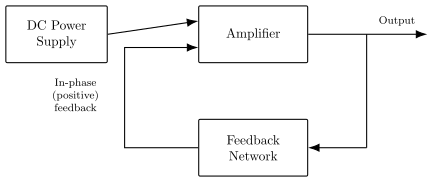
An oscillator converts DC power into a continuous AC (periodic) output, by feeding part of the amplified output back into the amplifier's input, in phase, with just enough gain to overcome losses.
Elementary idea of an oscillator:
An electronic oscillator is a circuit that generates a continuous, self-sustained, periodically-varying (usually sinusoidal) output signal of a definite frequency, using only a DC power supply as its energy source (i.e., no external oscillating input signal is needed).
It works on the principle of positive feedback: a fraction of the amplified output signal is fed back to the input, in the correct phase (i.e., in phase with the original input, so the feedback reinforces rather than cancels the signal), through a feedback network. If the loop gain (amplifier gain feedback fraction) is maintained at exactly unity (the Barkhausen criterion), the small initial disturbance (e.g., circuit noise, or a switch-on transient) builds up and sustains itself as a continuous oscillation at a frequency determined by the values of the components (usually an LC tank circuit, or an RC network) in the feedback path.
Block diagram:
   +-----------------------------+
   |                             |
   v                             |
[Amplifier] ---------> Output
   ^                    |
   |                    v …
Unlock everything free for 14 days
- Full step-by-step solutions
- Concept-first explanations
- Methods, shortcuts & mistakes
- PYQ mapping + timed mock tests
Full access for 14 days. No credit card required.