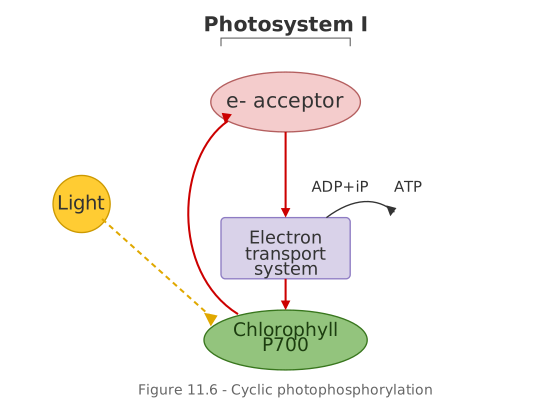
Q.a. What is photophosphorylation? Explain cyclic photophosphorylation with the help of a diagram.
OR
b. Describe C4 pathway with diagrammatic representation.
Nagaland NbseNagaland Board of School Education (Class XI) 2022Subjective· 5mImportance★★★★★
Concept understanding — Cyclic and Non-Cyclic Photophosphorylation
The Big Picture: Why Plants Need Two Kinds of Light Reactions
Photosynthesis has two jobs: make ATP (the energy currency) and make NADPH (the reducing power). Calvin cycle needs both — 3 ATP and 2 NADPH for every molecule of G3P it builds. But here's the problem: the light reactions don't always produce ATP and NADPH in that exact ratio. Sometimes the cell needs extra ATP without extra NADPH. That's where the two pathways come in.
Think of it like a factory. Non-cyclic photophosphorylation is the main assembly line — it produces both ATP and NADPH, plus oxygen as a byproduct. Cyclic photophosphorylation is a backup loop — it only makes ATP, no NADPH, no oxygen. The plant switches between them depending on what the Calvin cycle needs at that moment.
Non-Cyclic Photophosphorylation: The Main Line
This is the standard Z-scheme you see in every textbook. It involves both photosystems — PS II and PS I — working in series.
Step by step:
Light hits PS II (P680). An electron gets excited and is passed to a primary acceptor.
That electron is replaced by splitting water: 2H2O→4H++4e−+O2. This is the only source of oxygen in photosynthesis.
The excited electron travels down an electron transport chain (ETC) from PS II to PS I. As it moves through the cytochrome b6f complex, it pumps protons (H+) into the thylakoid lumen, building a gradient.
That proton gradient drives ATP synthase — photophosphorylation happens here. ATP is made.
The electron, now lower in energy, reaches PS I (P700). Light hits PS I, re-exciting the electron to a much higher energy level.
This high-energy electron is passed to ferredoxin (Fd) and then to NADP+ reductase, which reduces NADP+ to NADPH.
2H2O+2NADP++3ADP+3PilightO2+2NADPH+3ATP
The key point: electrons flow from water to NADP+ in a one-way path. They never return to where they started. That's why it's called non-cyclic.
Important
Non-cyclic photophosphorylation produces ATP, NADPH, and O2. It requires both PS II and PS I.
Cyclic Photophosphorylation: The Shortcut
Sometimes the Calvin cycle has enough NADPH but needs more ATP. The plant can't just make ATP without making NADPH — unless it uses a different route.
In cyclic photophosphorylation, only PS I is involved. PS II and water splitting are completely bypassed.
How it works:
Light excites PS I (P700). An electron is ejected and picked up by ferredoxin.
Instead of going to NADP+, the electron is shunted back to the cytochrome b6f complex (via plastoquinone).
It travels down the ETC again, pumping protons — generating ATP.
The electron eventually returns to PS I, filling the hole it left.
The electron goes in a circle: PS I → ferredoxin → plastoquinone → cytochrome b6f → plastocyanin → PS I. No water is split, no oxygen is released, no NADPH is made.
ADP+PilightATP(only ATP, no NADPH, no O2)
Watch out
A common mistake: thinking cyclic photophosphorylation produces NADPH. It does not. The electron never reaches NADP+ reductase — it loops back to PS I.
Photophosphorylation is the light-driven synthesis of ATP during photosynthesis. In cyclic photophosphorylation, only Photosystem I operates: the electron ejected from P700 cycles back to P700 via the electron transport chain, generating a proton gradient that is used to make ATP, with no NADPH or O2 produced. …
Figure — The answered alternative explains cyclic photophosphorylation with a diagram, and the catalog holds the exact
Photophosphorylation makes ATP using light energy; the cyclic pathway runs on PS I alone and yields only ATP.
Photophosphorylation is the process of ATP synthesis that occurs during the light reactions of photosynthesis, driven by the proton gradient (chemiosmotic potential) built up across the thylakoid membrane as electrons move through the electron transport chain.
Cyclic photophosphorylation: This occurs when only Photosystem I (PS I) is functioning, which happens mainly in the stroma lamellae that lack PS II and NADP reductase enzyme. Light excites the reaction centre P700 of PS I, ejecting a high-energy electron. Instead of being passed on to NADP+ to form NADPH, this electron is passed through a chain of electron carriers (including the cytochrome b6f complex and plastocyanin) and cycles back to the PS I reaction centre itself. As the electron passes through the cytochrome complex, protons are pumped into the thylakoid lumen, building a proton gradient that drives ATP synthase to produce ATP. Since the electron is recycled back to P700 and water is not sp …
Same / Similar Concept — real previous-year questions on the same or a closely similar concept, not this exact question.
CBSE 2021Set ANNUAL1 mark
Q.What is photo-phosphorylation?
›Reveal solutionSolution
ATP is generated in the thylakoid membrane during the light reaction, using energy from the electron transport chain set up by light absorption.
During the light reaction of photosynthesis, light energy absorbed by the photosystems drives electron flow through an electron transport chain embedded in the thylakoid membrane. This electron flow pumps protons (H+) into the thylakoid lumen, building up a proton gradient across the membrane. As these protons flow back out through the enzyme ATP synthase, the energy released is used to synthesize ATP from ADP and inorganic phosphate — this process is called photophosphorylation. It occurs in two …