Q.a. Explain the process of glycolysis with the help of a schematic representation. OR b. Explain the process of electron transport system with the help of diagrammatic representation.
You're viewing a preview — the full solution, concept, methods & PYQ mapping are locked.
Start your 14-day free trial to unlock the full solution →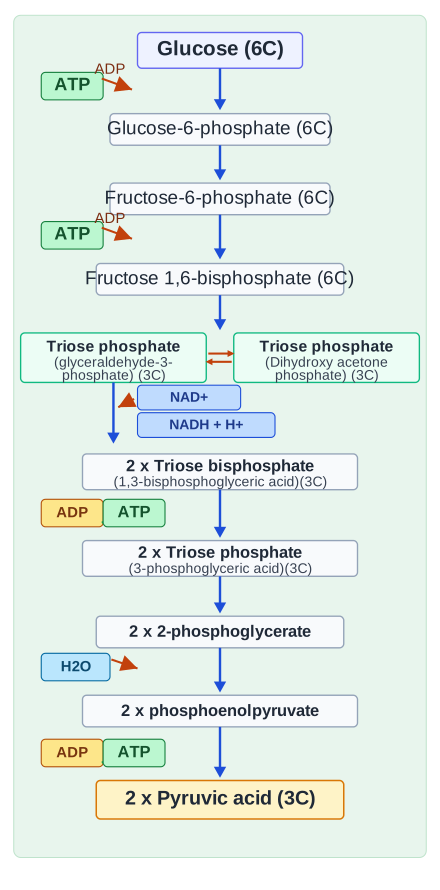
Glycolysis converts glucose to pyruvate in the cytosol; the electron transport system in mitochondria uses those electron carriers to make most of the cell's ATP.
a. Glycolysis (schematic outline):
Glycolysis (the Embden-Meyerhof-Parnas, EMP, pathway) occurs in the cytoplasm and proceeds in two broad phases:
Energy investment phase:
- Glucose is phosphorylated by hexokinase using ATP → glucose-6-phosphate.
- Isomerised to fructose-6-phosphate.
- Phosphorylated again by phosphofructokinase using ATP → fructose-1,6-bisphosphate.
- This 6-carbon sugar is split into two 3-carbon molecules: dihydroxyacetone phosphate (DHAP) and glyceraldehyde-3-phosphate (G3P); DHAP is converted to a second G3P, so the pathway continues with two 3-carbon units per glucose.
Energy generation phase (×2, since there are now two 3-carbon molecules):
5. G3P is oxidised and phosphorylated, generating NADH, forming 1,3-bisphosphoglycerate.
6. A phosphate is transferred to ADP (substrate-level phosphorylation) forming ATP and 3-phosphoglycerate.
7. Further rearrangement and dehydration steps lead to phosphoenolpyruvate (PEP).
8. A second substrate-level phosphorylation transfers PEP's phosphate to ADP, forming ATP and pyruvate.
Net result per glucose molecule: 2 pyruvate + net 2 ATP + 2 NADH (4 ATP produced − 2 ATP invested).
Or b. Electron transport system (ETS):
The ETS operates on the inner mitochondrial membrane (cristae). NADH and FADH₂ generated during glycolysis, pyruvate oxidation, and the Krebs cycle donate their high-energy electrons to a series of membrane-bound protein complexes:
- Complex I (NADH dehydrogenase) accepts electrons from NADH.
- Complex II (succinate dehydrogenase) accepts electrons from FADH₂. …
Unlock everything free for 14 days
- Full step-by-step solutions
- Concept-first explanations
- Methods, shortcuts & mistakes
- PYQ mapping + timed mock tests
Full access for 14 days. No credit card required.