Q.Explain why
You're viewing a preview — the full solution, concept, methods & PYQ mapping are locked.
Start your 14-day free trial to unlock the full solution →The key idea is that molecular structure and intermolecular forces govern these three distinct phenomena: (i) resonance delocalisation in chlorobenzene reduces its dipole moment compared to the purely inductive effect in cyclohexyl chloride;
(ii) alkyl halides cannot form strong hydrogen bonds with water despite being polar, so they remain immiscible;
(iii) Grignard reagents are violently reactive with water because the carbon–magnesium bond is highly polarised and carbanionic, so anhydrous conditions are essential to prevent decomposition.
(i) Why is the dipole moment of chlorobenzene lower than that of cyclohexyl chloride?
Concept and intuition
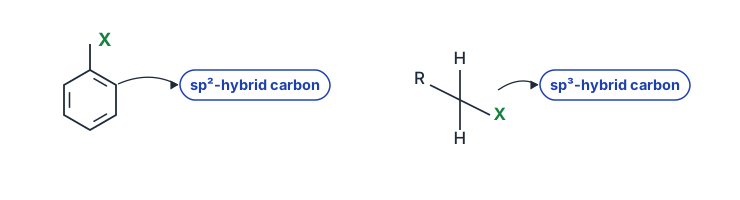
Dipole moment depends on both the magnitude of charge separation and the distance between the partial charges. In cyclohexyl chloride, the C–Cl bond is essentially a pure sigma bond with chlorine pulling electron density away from the sp³ carbon — a straightforward inductive effect. In chlorobenzene, the chlorine is attached to an sp² carbon of an aromatic ring. Here, the lone pairs on chlorine can participate in resonance with the π-system of the benzene ring, which changes the electron distribution significantly.
Step-by-step reasoning
-
Resonance in chlorobenzene
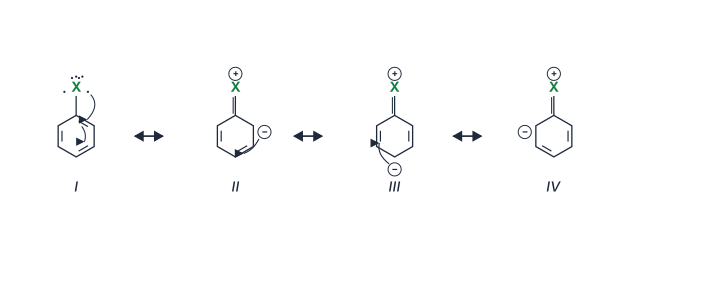
The chlorine atom has three lone pairs. One of these lone pairs can be delocalised into the aromatic ring via resonance, creating structures where the C–Cl bond acquires partial double-bond character. This resonance hybrid has a significant contribution from a structure where the chlorine bears a positive charge and the ortho and para positions of the ring bear negative charges.
-
Effect on bond polarity
In the resonance hybrid, the partial positive charge on chlorine partially cancels the partial negative charge that would normally reside on chlorine due to its electronegativity. The net result is that the C–Cl bond in chlorobenzene is less polar than a typical C–Cl single bond.
-
Comparison with cyclohexyl chloride
Cyclohexyl chloride has no such resonance possibility — the chlorine is on a saturated carbon. The C–Cl bond here is a pure sigma bond with full inductive electron withdrawal. The charge separation is larger, and the dipole moment is therefore higher.
-
Quantitative result
The dipole moment of chlorobenzene is about 1.69 D, while that of cyclohexyl chloride is about 2.20 D. The difference is directly attributable to resonance delocalisation reducing the effective polarity of the C–Cl bond in the aromatic compound.
A common mistake is to think that because chlorine is more electronegative, chlorobenzene should have a higher dipole moment. But resonance can reduce the dipole moment by spreading charge over the ring and even placing a partial positive charge on chlorine.
(ii) Why are alkyl halides, though polar, immiscible with water?
Concept and intuition
Miscibility is not simply about polarity — it is about the ability to form strong intermolecular attractions with the solvent. Water is a highly hydrogen-bonded solvent. For a solute to dissolve, it must be able to break water–water hydrogen bonds and replace them with comparable solute–water interactions. Alkyl halides fail this test.
Step-by-step reasoning
-
Nature of polarity in alkyl halides
The C–X bond (X = F, Cl, Br, I) is indeed polar, giving alkyl halides a net dipole moment. However, the molecule as a whole is largely nonpolar — the alkyl chain is hydrophobic, and the polar C–X bond is only a small part of the molecule.
-
Hydrogen bonding inability
For a molecule to be water-miscible, it must be able to form hydrogen bonds with water. Alkyl halides have no hydrogen atom attached to a highly electronegative atom (like O, N, or F), and the halogen atoms themselves, though electronegative, have lone pairs that are poor hydrogen bond acceptors compared to oxygen. The C–H bonds are not sufficiently polarised to participate in hydrogen bonding.
-
Energy penalty
When an alkyl halide is added to water, the water molecules must reorganise around the nonpolar alkyl chain, forming a cage-like structure (the hydrophobic effect). This costs energy. The weak dipole–dipole interactions between the alkyl halide and water are insufficient to compensate for the loss of water–water hydrogen bonds.
-
Result
The alkyl halide remains as a separate layer — it is immiscible. The polar C–X bond is simply not enough to overcome the hydrophobic nature of the rest of the molecule and the inability to form hydrogen bonds.
A useful rule of thumb: "like dissolves like" is too simplistic. The real criterion is whether the solute can participate in the same type of intermolecular forces as the solvent. For water, that means hydrogen bonding — polarity alone is not enough.
(iii) Why must Grignard reagents be prepared under anhydrous conditions?
Concept and intuition …
Unlock everything free for 14 days
- Full step-by-step solutions
- Concept-first explanations
- Methods, shortcuts & mistakes
- PYQ mapping + timed mock tests
Full access for 14 days. No credit card required.