Q.Write the mechanism of the following reaction:
You're viewing a preview — the full solution, concept, methods & PYQ mapping are locked.
Start your 14-day free trial to unlock the full solution →The reaction proceeds via an S_N2 mechanism because BuBr is a primary alkyl halide, and CN⁻ is a strong nucleophile. The cyanide ion attacks the electrophilic carbon from the back, displacing bromide in a single concerted step. The product is BuCN (butyronitrile).
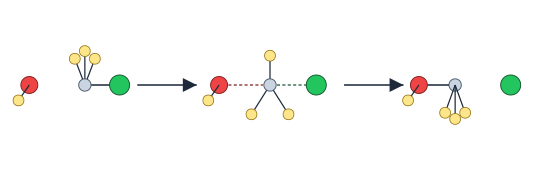
The figure shows the general S_N2 geometry with as the nucleophile (NCERT Fig 6.2); here the identical backside attack is performed by the carbon end of on the carbon of BuBr.
Why this mechanism? The concept of ambident nucleophiles
The cyanide ion (CN⁻) is an ambident nucleophile — it has two nucleophilic sites: the carbon atom and the nitrogen atom. In principle, attack could occur from either end, giving either an alkyl cyanide (R–CN) or an alkyl isocyanide (R–NC).
The key factor here is the solvent and the nature of the alkyl halide. In a protic solvent like ethanol–water, the harder (more electronegative) nitrogen end of CN⁻ is more strongly solvated by hydrogen bonding, which reduces its nucleophilicity. The softer carbon end remains more available for attack. For a primary alkyl halide like BuBr, the S_N2 pathway is strongly favoured, and the carbon end of CN⁻ attacks, yielding the nitrile.
A common mistake is to assume the counterion never matters. With KCN (ionic, free CN⁻) the carbon end attacks, giving the nitrile — but with AgCN the covalent Ag–C bond blocks the carbon end and the alkyl halide bonds to nitrogen instead, giving the isocyanide (BuNC). Here, KCN plus the protic solvent and primary substrate ensure clean carbon attack.
Step-by-step mechanism
1. Identify the substrate and nucleophile
BuBr is a primary alkyl bromide — the carbon bearing the leaving group (Br) is attached to only one other carbon. This means there is minimal steric hindrance, and the S_N2 mechanism is strongly favoured.
KCN dissociates in the aqueous ethanol to give K⁺ and CN⁻. The CN⁻ ion is a strong nucleophile and a weak base (pKa of HCN ≈ 9.2), so elimination is not a concern.
2. The S_N2 attack — backside displacement
The lone pair on the carbon atom of CN⁻ (the nucleophile) approaches the electrophilic carbon of BuBr from the side opposite the Br atom (backside attack). This is the hallmark of S_N2: the nucleophile attacks as the leaving group departs, in a single concerted step.
3. The transition state
In the transition state, the carbon is partially bonded to both the incoming CN⁻ and the outgoing Br⁻. The geometry around carbon is trigonal bipyramidal (with the nucleophile and leaving group in the axial positions). The three alkyl groups (the Bu chain) are in the equatorial plane.
4. Inversion of configuration …
Unlock everything free for 14 days
- Full step-by-step solutions
- Concept-first explanations
- Methods, shortcuts & mistakes
- PYQ mapping + timed mock tests
Full access for 14 days. No credit card required.