Biology · Ch 4 — Animal Kingdom
Symmetry
Symmetry
Animals can also be sorted according to their body symmetry — that is, whether the body can be divided into matching halves, and in how many planes such a division is possible. Three conditions are recognised.
Asymmetry. Some animals cannot be divided into two equal halves by any plane passing through the centre of the body. Such animals are asymmetrical. Sponges are mostly of this kind.
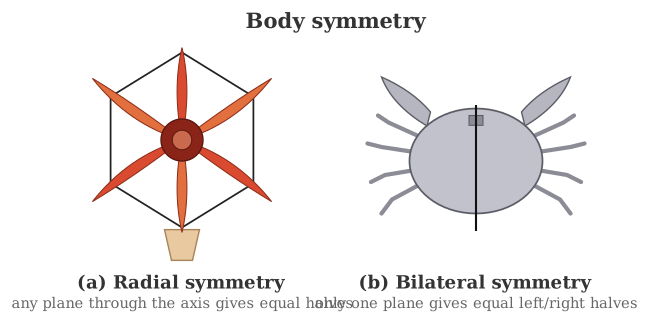
Radial symmetry. When any plane passing through the central axis of the body divides the animal into two identical halves, the body plan is radially symmetrical. Because the plane can be taken in more than one direction through the central axis and still yield equal halves, the parts are arranged around a central line. Coelenterates, ctenophores and echinoderms show radial symmetry. …
Drawn by us to help you understand the concept clearly, and verified to make sure it's accurate. For exams, practice from your textbook's own diagram.
This pair of figures contrasts the two kinds of body symmetry used in classification. In (a), a radially symmetrical organism such as a sea anemone or Hydra is shown with several straight lines drawn through its central axis at different angles; each of these lines divides the body into two identical, mirror-image halves, which is what "radial" means -- many different cutting planes through the centre all work equally well. In (b), a bilaterally symmetrical animal, a crab seen from above, is shown with only ONE line, running from front to back through the midline, that divides the body into matching left and right halves; any other plane through the body would give two unequal, non-matching pie …