Biology · Ch 18 — Neural Control and Coordination
Generation and Conduction of Nerve Impulse
Generation and Conduction of Nerve Impulse
Neurons are excitable cells — cells able to be stimulated — and this excitability arises because their membranes are kept in a polarised state. Understanding how that polarised state is set up, and then reversed, explains how a nerve impulse is generated and conducted.
The resting state (resting potential)
The neuron's membrane is selectively (differentially) permeable: it carries different types of ion channels, and each channel lets only particular ions pass. When the neuron is at rest — not conducting any impulse — these are the conditions:
- The membrane is comparatively more permeable to potassium ions (K+) and almost impermeable to sodium ions (Na+). It is also impermeable to the large, negatively charged proteins present in the axoplasm.
- As a result, the axoplasm inside the axon holds a high concentration of potassium ions and negatively charged proteins, with a low concentration of sodium ions.
- The fluid outside the axon, by contrast, has a low concentration of potassium ions and a high concentration of sodium ions.
These opposing concentrations set up ionic gradients across the membrane. The gradients are actively maintained by the sodium-potassium pump, which pumps three sodium ions out of the cell for every two potassium ions it moves in.
Because of this arrangement, the outer surface of the resting membrane carries a positive charge while the inner surface becomes negatively charged — the membrane is therefore polarised. The electrical potential difference across the resting membrane is called the resting potential.
Generation of the nerve impulse (depolarisation)
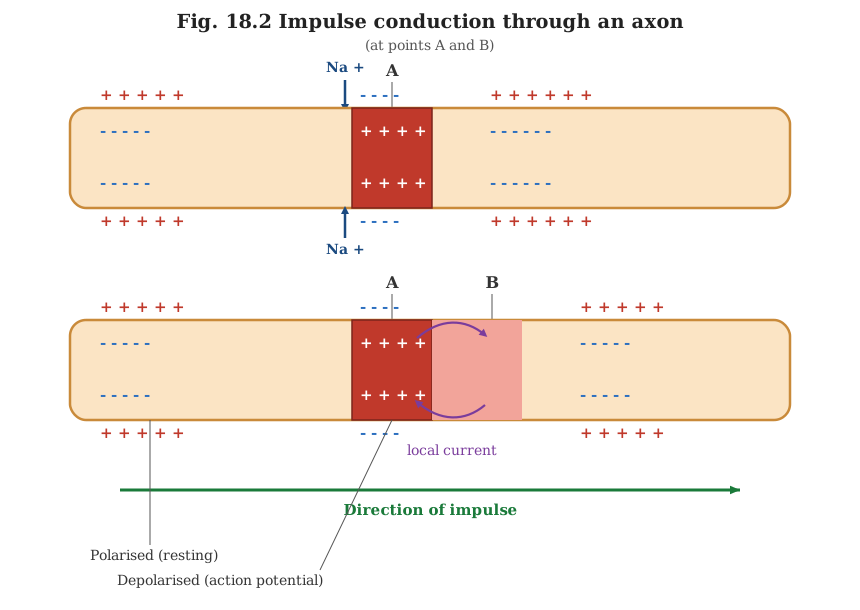
When a stimulus is applied at a point on the polarised membrane (call it site A), the membrane there suddenly becomes freely permeable to sodium ions. Sodium ions rush inward in a rapid influx, and this causes the polarity to reverse at that site: the outer surface now becomes negatively charged and the inner surface becomes positively charged. The membrane at site A is thus depolarised. The electrical potential difference produced across the membrane at this depolarised site is called the action potential, and this action potential is what we call a nerve impulse.
Conduction along the axon
At the region just ahead of site A (call it site B), the membrane is still in the resting, polarised condition — positive on the outer surface and negative on the inner surface. Because site A and site B now have opposite polarities, a local electric current flows: on the inner surface the current runs from site A to site B, and on the outer surface it runs from site B back to site A, completing the circuit. …
Drawn by us to help you understand the concept clearly, and verified to make sure it's accurate. For exams, practice from your textbook's own diagram.
The figure captures a nerve impulse in the act of travelling along an axon. Most of the membrane is shown in its resting, polarised state — positive charges on the outside and negative charges on the inside — because the sodium-potassium pump keeps sodium concentrated outside and potassium inside. At the stimulated point, labelled A, the membrane has briefly become permeable to sodium; sodium has rushed in and the polarity has flipped, so A is now negative outside and positive inside. This reversed patch is the action potential, or depolarised region. Just ahead of it, point B is still polarised. Because A and B now carry opposite charges across the membrane, a small local current flows between them, shown by the curved arrow. That current depolarises B in turn, and the sequence repeats point after point, so the impulse is carried steadily forward in th …