Biology · Ch 18 — Neural Control and Coordination
Transmission of Impulses
Transmission of Impulses
A nerve impulse does not stay confined to a single neuron; it has to be handed over from one neuron to the next so that information can travel through the nervous system. This handover happens at specialised junctions called synapses. A synapse is formed where the membrane of one neuron meets the membrane of the next. The neuron that carries the impulse up to the junction is the pre-synaptic neuron, and the neuron that receives it on the other side is the post-synaptic neuron. Between these two membranes there may or may not be a gap, and the nature of this junction decides how the impulse is passed on.
Based on how the signal crosses the junction, there are two kinds of synapses.
Electrical synapses
At an electrical synapse the membranes of the pre-synaptic and post-synaptic neurons lie extremely close together. Because the two cells are almost touching, electrical current can flow straight from one neuron into the next across the junction. As a result:
- The way an impulse crosses an electrical synapse is much like the way it moves along a single continuous axon — the signal simply continues onward.
- Transmission is very fast, faster than at a chemical synapse, because there is no intermediate chemical step to slow it down.
- Such synapses are rare in the human body.
Chemical synapses
At a chemical synapse the two neurons are not in direct contact. Their membranes are separated by a narrow, fluid-filled gap called the synaptic cleft. Since electricity cannot jump this gap directly, the impulse is carried across using chemical messengers known as neurotransmitters. The axon terminals of the pre-synaptic neuron hold tiny sacs, the synaptic vesicles, which are packed with these neurotransmitters.
The step-by-step process of transmission across a chemical synapse is as follows:
- An impulse, in the form of an action potential, travels down the pre-synaptic neuron and arrives at its axon terminal.
- The arrival of the impulse triggers the movement of the synaptic vesicles towards the pre-synaptic membrane (this is set off by the entry of Ca2+, calcium ions, into the terminal).
- The vesicles fuse with the pre-synaptic membrane and release their neurotransmitters into the synaptic cleft.
- The released neurotransmitters diffuse across the cleft and bind to specific receptors on the post-synaptic membrane.
- This binding opens ion channels in the post-synaptic membrane, allowing ions to move across it. …
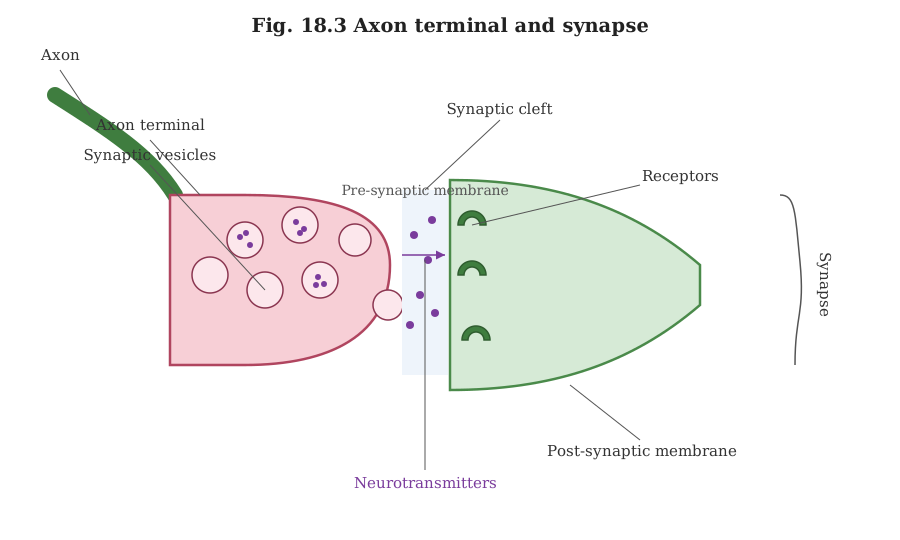
Drawn by us to help you understand the concept clearly, and verified to make sure it's accurate. For exams, practice from your textbook's own diagram.
This diagram enlarges the junction — the synapse — where one neuron hands its signal to the next. On the left is the synaptic knob at the end of the pre-synaptic neuron's axon; inside it are many small membrane-bound synaptic vesicles, each packed with a chemical messenger called a neurotransmitter. A narrow gap, the synaptic cleft, separates this knob from the post-synaptic neuron on the right, whose membrane carries receptor proteins and ion channels. The figure lays out the steps of chemical transmission: when an impulse reaches the knob it makes the vesicles move to and fuse with the pre-synaptic membrane, releasing their neurotransmitter into the cleft; the transmitter then diffuses across the gap and binds the receptors on the post-synaptic membrane. This binding opens the ion channels, letting ions flow and generating a fresh potential in the next neuron — which may be exci …