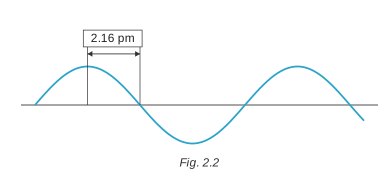
Q.A hypothetical electromagnetic wave is shown in the figure below. Find out the wavelength of the radiation.
You're viewing a preview — the full solution, concept, methods & PYQ mapping are locked.
Start your 14-day free trial to unlock the full solution →The distance from a crest to an immediately following node in a sinusoidal wave represents one-quarter of its full wavelength. Given this distance as 2.16 pm, the wavelength is .
Electromagnetic waves, like all waves, exhibit a periodic pattern. When we represent them as a smooth sinusoidal wave, certain points on the wave have specific names and relate directly to the wave's fundamental length scale: its wavelength. Understanding these basic anatomical features of a wave is crucial for solving problems involving wave properties.
-
Understanding Wave Anatomy:
A sinusoidal wave oscillates around a central equilibrium position (the horizontal axis in this case).
- A crest is a point on the wave where its displacement from the equilibrium position is maximum in the positive direction.
- A trough is a point where its displacement is maximum in the negative direction.
- A node (or zero-crossing point) is a point where the wave crosses the equilibrium axis, meaning its displacement is zero.
- The wavelength () is the spatial period of the wave, which is the distance over which the wave's shape repeats. It can be measured, for example, from one crest to the next adjacent crest, or from one trough to the next adjacent trough.
-
Relating Crest-to-Node Distance to Wavelength:
Consider a full cycle of a sinusoidal wave.
- From a crest to the next trough is half a wavelength ().
- From a crest to the immediately following node (where the wave crosses the axis going downwards) is exactly one-quarter of a wavelength ().
- Similarly, from a node to the immediately following crest (where the wave crosses the axis going upwards) is also one-quarter of a wavelength (). …
Unlock everything free for 14 days
- Full step-by-step solutions
- Concept-first explanations
- Methods, shortcuts & mistakes
- PYQ mapping + timed mock tests
Full access for 14 days. No credit card required.