Mathematics · Ch 10 — Conic Sections
Degenerated Conic Sections
Degenerated Conic Sections
The Degenerate Cases: When the Cone Meets the Vertex
Up to this point, we have considered planes that cut through a double-napped cone at various angles, producing the familiar curves: circles, ellipses, parabolas, and hyperbolas. But what happens when the cutting plane passes exactly through the vertex of the cone? The resulting sections are no longer the smooth, infinite curves we have studied. They are called degenerate conic sections — special cases where the conic "collapses" into something simpler.
The key idea is this: a plane through the vertex can intersect the cone in only three ways, depending on the angle that the plane makes with the vertical axis, relative to the semi-vertical angle of the cone.
Recall that is the angle between the generator (the slant line) of the cone and its axis. is the angle between the cutting plane and the axis. The cone is double-napped, so the vertex is the common point of both nappes.
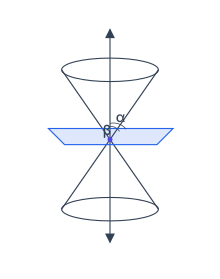
Case (a): When — The Section is a Single Point
If the plane is tilted so steeply that its angle with the axis is greater than the cone's semi-vertical angle, the plane will touch the cone only at the vertex itself. It cannot cut through any other part of the cone because the plane is too "flat" relative to the cone's slope.
The result is a single point — the vertex. This is the degenerate case of both an ellipse and a circle. Think of it as a circle whose radius has shrunk to zero.
When , the intersection is a single point (the vertex). This is the degenerate form of an ellipse (and of a circle).
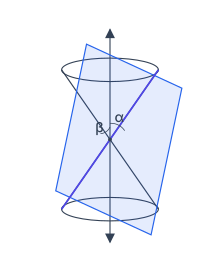
Case (b): When — The Section is a Straight Line
Now suppose the plane is tilted so that its angle with the axis is exactly equal to the semi-vertical angle of the cone. In this situation, the plane is parallel to one of the generators of the cone. It will cut through the cone along that entire generator — a straight line that passes through the vertex.
This is the degenerate case of a parabola. A parabola, in its standard form, is an open curve that extends to infinity. When the plane passes through the vertex and is parallel to a generator, the parabola "flattens" into a single straight line.
Do not confuse this with the non-degenerate parabola. In the standard parabola, the plane is parallel to a generator but does not pass through the vertex. Here, the plane does pass through the vertex, collapsing the curve to a line.
When , the intersection is a single straight line (the generator itself). This is the degenerate case of a parabola.
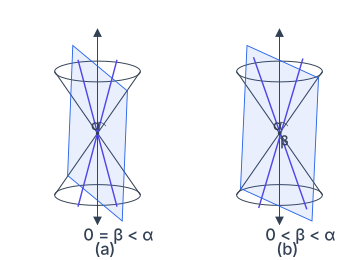
Case (c): When — The Section is a Pair of Intersecting Straight Lines
Finally, consider a plane that makes an angle with the axis that is smaller than the cone's semi-vertical angle. Such a plane will cut through both nappes of the cone. But because it passes through the vertex, it does not produce the two separate branches of a hyperbola. Instead, it cuts through the cone along two straight lines that cross at the vertex.
These two lines are the generators of the cone that lie in the cutting plane. They intersect at the vertex, forming an "X" shape.
This is the degenerate case of a hyperbola. A standard hyperbola has two separate, non-intersecting branches. When the plane goes through the vertex, those two branches collapse into two intersecting lines.
When , the intersection is a pair of intersecting straight lines. This is the degenerate case of a hyperbola. …
Drawn by us to help you understand the concept clearly, and verified to make sure it's accurate. For exams, practice from your textbook's own diagram.
Fig. 10.8 is a diagram of a double cone (two cones meeting at a common vertex V) with a cutting plane passing through that vertex. The plane is tilted so that the angle it makes with the cone’s axis — call this angle — is larger than the cone’s semi-vertical angle , but still less than or equal to . In other words, .
The key visual: the plane slices the cone only at the single point V. It does not cut through any other part of the cone’s surface. So the intersection — the “section” — is just that one point. The diagram marks this point in indigo at V, and the two angles and are labelled to show the relationship.
What this teaches is the idea of a degenerate conic section. A non-degenerate conic (circle, ellipse, parabola, hyperbola) is formed when the plane cuts through the cone away from the vertex. But when the plane passes exactly through the vertex, the intersection shrinks to a simpler shape. Here, because the plane is steeper than the cone’s side (), it touches only the vertex — giving a single point. This is the degenerate case of an ellipse (or a circle, if ).
The textbook uses this figure to ground the concept that conic sections are not always curves; they can collapse into points, lines, or pairs of lines. The formulas that follow in the chapter define each conic by a geometric property (like distance from a focus), but the degenerate cases remind us that those definitions have edge cases.
The condition for a point-section is . Here is the semi-vertical angle of the cone (the angle between the axis and a generator), and is the angle between the cutting plane and the axis. When the plane is steeper than the cone’s side and passes through the vertex, the only intersection is the vertex itself. …
Drawn by us to help you understand the concept clearly, and verified to make sure it's accurate. For exams, practice from your textbook's own diagram.
Fig. 10.9 is a three-dimensional sketch of a double cone (two cones meeting at a common vertex V) with a cutting plane passing through V. The plane is tilted so that it exactly contains one of the straight lines (generators) that lie on the surface of the cone. That particular generator is drawn as a bold indigo line. Two angles are marked at the vertex: , the semi-vertical angle of the cone (the angle between the cone’s axis and any generator), and , the angle between the cutting plane and the cone’s axis. In this figure, .
The physical idea is simple: when a plane cuts through the vertex of a double cone, the intersection is no longer a smooth curve like a parabola, ellipse, or hyperbola — it degenerates into something simpler. If the plane is tilted so that it just grazes the cone along one of its generators (i.e., the plane contains that generator), the intersection is exactly that straight line. The textbook calls this the degenerate case of a parabola because a parabola is the conic you get when but the plane does not pass through the vertex. Here, because the plane goes through V, the parabola collapses into a single line.
The key relation is the condition for degeneracy: . There is no separate formula for the line itself in this figure — the textbook uses the geometry to set up the idea that a conic section can shrink to a point, a line, or a pair of lines when the cutting plane passes through the vertex. The actual equations for the non-degenerate conics come later, but this figure establishes the boundary case: when the plane contains a generator, the section is a straight line.
A common mistake is to think that the bold indigo line is the axis of the cone. It is not — it is a generator, a line on the cone’s surface. The axis is a different line through V, perpendicular to the base. The generator shown lies exactly in the cutting plane, which is why the intersection is that line and nothing else. …
Drawn by us to help you understand the concept clearly, and verified to make sure it's accurate. For exams, practice from your textbook's own diagram.
Fig. 10.10 shows the geometric situation that produces a degenerate hyperbola — a pair of intersecting straight lines. The figure has two panels, (a) and (b), each built around the same double cone.
In both panels, the cone is drawn as two identical nappes meeting at the vertex . A plane passes through and cuts through both nappes. The key difference between the two panels is the angle the plane makes with the axis of the cone.
Let be the semi-vertical angle of the cone (the constant angle between the axis and any generator — a straight line on the cone’s surface). Let be the angle between the cutting plane and the axis.
Panel (a) is labelled . Here the plane is horizontal — it makes an angle with the axis, so it is perpendicular to the axis. Because is less than , the plane cuts through the vertex and slices both nappes. The intersection is a pair of straight lines that cross at . These lines are the two generators of the cone that lie in the cutting plane.
Panel (b) is labelled . The plane is now tilted, but still passes through and still makes an angle that is smaller than . Again, the plane cuts both nappes, and the intersection is a pair of straight lines through . The lines are different from those in panel (a) — they are the two generators that happen to lie in this particular tilted plane.
In both cases, the intersection is not a smooth curve like a hyperbola; it is two straight lines that cross at the vertex. This is why the textbook calls it a degenerated case of a hyperbola — a hyperbola normally has two separate branches that never meet, but here the two branches have collapsed into straight lines that intersect.
A common mistake is to think that any plane through the vertex gives a pair of lines. That is only true when . If , the plane contains exactly one generator and the section is a single straight line (a degenerate parabola). If , the plane touches only the vertex and the section is a single point (a degenerate ellipse/circle).
The physical idea the figure teaches is this: a hyperbola is the curve you get when a plane cuts both nappes of a cone but does not pass through the vertex. When you slide that plane down so it passes through the vertex, the two separate branches of the hyperbola shrink into two straight lines that cross at the vertex. The condition is the mathematical description of when this happens.
The textbook does not derive a formula directly from this figure — the figure is purely geometric. However, the condition is the foundation for the standard equation of a hyperbola. Later in the chapter, the standard form of a hyperbola is given as:
…