Mathematics · Ch 10 — Conic Sections
Sections of a Cone
Sections of a Cone
The Cone: A Surface, Not a Solid
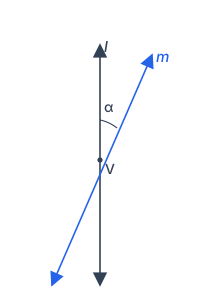
Before we cut anything, we need a clear picture of the object being cut. Take a fixed vertical line . Now take another line that intersects at a fixed point , and is tilted away from by a fixed angle (see Fig 10.1 in your textbook). If you rotate the line all the way around — keeping the angle constant — the line sweeps out a surface. That surface is a double-napped right circular hollow cone.
The word "right" here means the axis is perpendicular to the base of the cone (if you imagine a flat base). "Circular" means any cross-section perpendicular to the axis is a circle. "Double-napped" means it extends infinitely in both directions from the vertex — there is no flat base.
The key parts of this cone are:
- Vertex (): The fixed point where the two lines meet.
- Axis (): The fixed vertical line about which the rotation happens.
- Generator (): The rotating line itself. Every position of during the rotation is a generator of the cone.
- Nappes: The vertex splits the cone into two separate, mirror-image halves. Each half is called a nappe. One nappe opens upward, the other opens downward.
The Section: The Cut Itself
A conic section is simply the curve you get when you slice this double-napped cone with a plane. The shape of that curve — whether it's a circle, a parabola, an ellipse, or a hyperbola — depends entirely on two things:
- The angle the cutting plane makes with the vertical axis of the cone. Let's call this angle .
- Whether the plane cuts through the vertex or through the body of the cone (one or both nappes).
The textbook introduces as the angle between the cutting plane and the vertical axis . The fixed angle of the cone itself is (the angle between the generator and the axis ). The relationship between and determines everything.
The Four Cases: How the Shape Depends on
Here is the complete classification, exactly as the book presents it. The plane is assumed to be horizontal for the purpose of visualising the angle , but the principle is general.
The angle is fixed by the cone. The angle is chosen by the cutting plane. The resulting conic section is determined by comparing to .
Case 1: (The plane is horizontal)
The cutting plane is perpendicular to the axis . It slices through a single nappe, parallel to its base. The curve of intersection is a circle. This is the simplest case.
Case 2: (The plane is tilted, but steeper than the cone's side)
The cutting plane is still cutting through only one nappe, but it is now tilted. It is not parallel to a generator. The curve of intersection is an ellipse. A circle is a special case of an ellipse (when ).
Case 3: (The plane is parallel to a generator)
The cutting plane is now tilted so that it is exactly parallel to one of the generators of the cone. It still cuts through only one nappe. The curve of intersection is a parabola. The plane never meets the other nappe.
Case 4: (The plane is tilted less steeply than the cone's side)
This is the critical case. The cutting plane is now so shallow that it cuts through both nappes of the cone. The curve of intersection consists of two separate, open branches. This curve is a hyperbola.
A common mistake is to think a hyperbola is just two parabolas. It is not. A hyperbola has a specific geometric definition and a specific equation form that is fundamentally different from a parabola. The two branches are mirror images of each other.
The Degenerate Cases: When the Plane Passes Through the Vertex
All the cases above assume the cutting plane does not pass through the vertex . If the plane does pass through the vertex, the "curve" of intersection degenerates into a simpler geometric object. These are called degenerate conic sections.
- If (plane cuts through vertex and is steeper than the cone's side): The intersection is a single point — the vertex itself.
- If (plane is parallel to a generator and passes through the vertex): The intersection is a single straight line — the generator itself.
- If (plane cuts through both nappes and passes through the vertex): The intersection is a pair of intersecting straight lines.
The Complete Classification Table
The textbook builds this table implicitly. Here it is explicitly, summarising everything. …
Drawn by us to help you understand the concept clearly, and verified to make sure it's accurate. For exams, practice from your textbook's own diagram.
Fig. 10.1 is a schematic that builds the definition of a right circular cone from two lines. The fixed vertical line (drawn with a double arrowhead to show it extends infinitely in both directions) is the axis of the cone. The slanted line (often shown in a different colour, like blue) is the generator — it will sweep out the cone's surface. The two lines intersect at point , the vertex. The acute angle between and at is labelled ; this is the semi-vertical angle of the cone.
The physical idea is simple: imagine holding a fixed vertical rod (line ) and a second rod (line ) hinged at so that the angle between them stays exactly . If you rotate around like a spinning skipping rope, the path traced by in space is the surface of a double-napped right circular cone. The word "double-napped" means the cone extends both above and below — two identical cones meeting at the vertex, like an hourglass shape. Every position of during this rotation is called a generator of the cone.
This figure is the foundation for classifying conic sections. Once the cone is defined, the textbook introduces a second angle : the angle that a cutting plane makes with the vertical axis . The type of curve you get — circle, ellipse, parabola, or hyperbola — depends entirely on how compares to .
The central classification rule is:
where is the semi-vertical angle of the cone and is the angle the cutting plane makes with the vertical axis .
Every symbol in that rule comes directly from Fig. 10.1 and its companion Fig. 10.3: is the fixed angle between and at , and is the angle between the cutting plane and the axis . When the plane is horizontal (), you get a circle. As the plane tilts, the curve stretches into an ellipse, then a parabola when the plane is exactly parallel to a generator (), and finally a hyperbola when the plane cuts both nappes (). …
Drawn by us to help you understand the concept clearly, and verified to make sure it's accurate. For exams, practice from your textbook's own diagram.
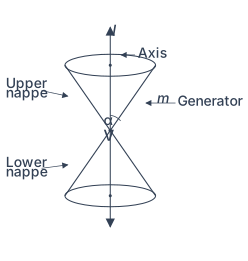
The figure shows a double-napped right circular cone — the central object from which all conic sections are born. At the heart of the diagram is the point V, the vertex, where the two halves of the cone meet. A straight vertical line labelled l passes through V and runs the full height of the figure; this is the axis of the cone. Slanting away from the axis is a second straight line labelled m, the generator. The generator makes a fixed angle with the axis at V.
The cone itself is drawn as two elliptical rims — one at the top, one at the bottom — connected by two straight generator lines that cross at V. The upper half of the cone, above V, is the upper nappe; the lower half, below V, is the lower nappe. The generator m is shown in one particular position, but the idea is that m sweeps around the axis l, always keeping the same angle , to trace out the entire conical surface.
The elliptical rims in the diagram are just a visual convenience — the cone actually extends infinitely far in both directions. The rims help you see the shape, but the cone has no top or bottom.
The physical idea the figure teaches is simple: a right circular cone is formed by rotating a line (the generator) around another line (the axis) at a fixed angle. The vertex is the only point where the two nappes meet. Every point on the surface of the cone lies on some generator, and every generator makes the same angle with the axis.
From this figure, the textbook develops the key relationship that governs all conic sections. When a plane cuts the cone, the angle that the plane makes with the vertical axis determines which curve you get. The central formula is the condition that relates the cutting angle to the cone's fixed angle :
…
Drawn by us to help you understand the concept clearly, and verified to make sure it's accurate. For exams, practice from your textbook's own diagram.
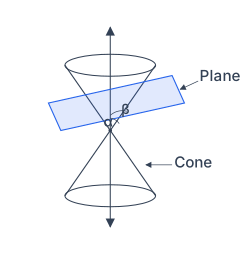
Fig. 10.3 is the key diagram that turns the abstract definition of a cone into the concrete geometry that produces each conic section. It shows a double-napped cone — the full, two-sided surface generated by rotating a line around a vertical axis — and a single, tilted plane cutting through it.
The plane is drawn as a blue parallelogram, a visual convention that makes its orientation clear without cluttering the diagram. It slices through only the upper nappe of the cone, not the lower one. At the vertex , two angles are marked: , the constant angle between the generator and the axis , and , the angle between the cutting plane and the axis . The labels "Plane" and "Cone" are placed directly on the respective surfaces.
The physical idea is simple but powerful: the shape of the curve where the plane meets the cone depends entirely on how compares to . If the plane is nearly horizontal ( close to ), the intersection is a circle. Tilt it a little ( but not ), and you get an ellipse. Tilt it exactly so the plane is parallel to a generator (), and the curve becomes a parabola. Tilt it even steeper (), and the plane cuts both nappes, producing a hyperbola.
The entire classification of conic sections flows from one inequality:
- → circle (a special ellipse)
- → ellipse
- → parabola
- → hyperbola
The textbook develops no single formula directly from this figure, but it establishes the geometric foundation for the standard equations that follow. The relationship between and determines the eccentricity of the conic, which later appears as the ratio of distances from a point on the curve to a fixed point (focus) and a fixed line (directrix). For a right circular cone, the eccentricity is given by:
where is the semi-vertical angle of the cone (the angle between the axis and a generator), and is the angle between the cutting plane and the axis. When , (parabola); when , , so (ellipse); when , , so (hyperbola). The circle corresponds to , giving . …