Mathematics · Ch 3 — Trigonometric Functions
Sign of Trigonometric Functions
Sign of Trigonometric Functions
Concept First: The Unit Circle and Coordinates
The sign of a trigonometric function for a given angle is determined entirely by the quadrant in which the terminal side of the angle lies. To see why, we return to the unit circle definition.
Let be a point on the unit circle (radius 1) centred at the origin , such that the angle (measured from the positive -axis). By definition, and . Since lies on the unit circle, and are the - and -coordinates of , respectively.
The key observation is that and can be positive, negative, or zero, depending on which quadrant falls in. The sign of is simply the sign of , and the sign of is the sign of . From there, the signs of the other four trigonometric functions follow directly from their definitions in terms of and .
Sign of and
Consider a point on the unit circle corresponding to angle . Now consider the angle , which is the same magnitude as but measured clockwise from the positive -axis. The point corresponding to angle will be the reflection of across the -axis. Therefore, if has coordinates , then has coordinates .
From this geometric fact, we immediately get two fundamental identities:
These are the even-odd identities for cosine and sine: cosine is an even function, and sine is an odd function.
and for all .
Bounds of Sine and Cosine
Since every point on the unit circle satisfies and , we have the fundamental bounds:
These bounds are crucial: sine and cosine never exceed 1 in absolute value.
Sign of Trigonometric Functions in Each Quadrant
We now determine the sign of and in each quadrant by examining the signs of and .
First Quadrant (): Both and are positive. Therefore:
Second Quadrant (): is negative, is positive. Therefore:
Third Quadrant (): Both and are negative. Therefore:
Fourth Quadrant (): is positive, is negative. Therefore:
From these, we can summarise:
- is positive for (first and second quadrants) and negative for (third and fourth quadrants).
- is positive for (first quadrant) and for (fourth quadrant), and negative for (second and third quadrants).
Signs of the Other Trigonometric Functions
The signs of , , , and follow from their definitions:
The sign of is the sign of the ratio . So:
- In Quadrant I:
- In Quadrant II:
- In Quadrant III:
- In Quadrant IV:
Similarly, has the same sign as (since it is its reciprocal). has the same sign as (reciprocal), and has the same sign as (reciprocal).
Complete Sign Table
The following table summarises the signs of all six trigonometric functions in the four quadrants. …
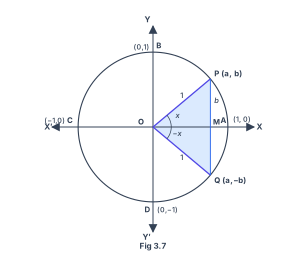
Drawn by us to help you understand the concept clearly, and verified to make sure it's accurate. For exams, practice from your textbook's own diagram.
The figure is built around the unit circle — a circle of radius 1 centred at the origin. The horizontal axis is the -axis and the vertical axis is the -axis. Four quadrantal points are marked on the circle: at angle , at , at , and at .
A radius is drawn to a point in the first quadrant, making an angle measured anticlockwise from the positive -axis. A second radius is drawn to a point in the fourth quadrant, making an angle measured clockwise from the positive -axis. Both and share the same horizontal coordinate because they are symmetric across the -axis; their vertical coordinates are opposites ( and ).
A vertical line from meets the -axis at a foot , forming a right triangle . The same foot is used for triangle , which is the mirror image of reflected across the -axis. Both triangles are shaded, and both radii and are labelled with length . The angles and are shown as arcs at the origin , one going anticlockwise from to , the other clockwise from to .
The key geometric idea is reflection symmetry. Reflecting a point on the unit circle across the -axis changes the sign of its -coordinate but leaves the -coordinate unchanged. This is the entire physical basis for the even/odd behaviour of cosine and sine.
From the coordinates of and , the textbook reads the fundamental relations directly. On the unit circle, the -coordinate of a point is of its angle and the -coordinate is of its angle. So for :
For , whose angle is :
Substituting and gives the two central formulas:
Cosine is an even function — it does not change sign when the angle is negated. Sine is an odd function — it flips sign.
The figure also grounds the sign conventions for trigonometric functions in the four quadrants. Because lies in the first quadrant (), both and are positive, so and . As the angle moves into other quadrants, the signs of and change according to the table given in the textbook. The figure itself only shows the first and fourth quadrants, but the pattern extends by symmetry: reflecting across the -axis would give the second and third quadrants. …