Physics · Ch 4 — Laws of Motion
Circular Motion
Circular Motion
Circular Motion
The Centripetal Force Requirement
From Chapter 3, we already know that a body moving in a circle of radius with uniform speed experiences an acceleration directed toward the centre. Newton's second law then tells us that a force must be providing this acceleration. That force is
where is the mass of the body. This inward-directed force is called the centripetal force.
The physical source of the centripetal force changes with the situation. For a stone whirled in a circle by a string, the tension in the string provides it. For a planet orbiting the Sun, the gravitational pull of the Sun on the planet does the job. For a car taking a circular turn on a horizontal road, the centripetal force comes from friction between the tyres and the road.
Two particularly instructive applications are the motion of a car on a level road and on a banked road. These show how the laws of motion combine with geometry to determine safe speeds.
Motion of a Car on a Level Road
Three forces act on the car as it moves on a horizontal circular track:
- The weight of the car, , acting vertically downward.
- The normal reaction from the road, , acting vertically upward.
- The frictional force, , acting horizontally along the surface of the road.
Since there is no acceleration in the vertical direction, the vertical forces must balance:
The centripetal force needed for circular motion acts along the surface of the road, toward the centre of the circle. This force is provided by the component of the contact force between the road and the tyres that lies along the surface — that is, by the frictional force. Static friction is what opposes the impending motion of the car away from the circle.
It is static friction, not kinetic friction, that provides the centripetal force here. The car's tyres are not sliding relative to the road; they are rolling. The friction that prevents slipping at the contact point is static friction.
The maximum value of static friction is , where is the coefficient of static friction. For the car to stay on its circular path without slipping, the required centripetal force must not exceed this maximum:
Using , this becomes
Cancelling from both sides gives
The maximum safe speed on a level road is therefore
Notice that this result is independent of the mass of the car. For a given radius of turn and coefficient of friction , every vehicle has the same maximum safe speed.
Motion of a Car on a Banked Road
If the road is banked — that is, tilted at an angle to the horizontal — the normal reaction itself has a horizontal component that can contribute to the centripetal force. This reduces the reliance on friction and allows a higher safe speed.
Consider a car moving on a road banked at angle . The forces acting are the same three — weight , normal reaction , and friction — but now is not vertical and is not horizontal. The road surface is tilted, so both and have vertical and horizontal components.
Force Balance in the Vertical Direction
Since there is no acceleration vertically, the net vertical force must be zero. The vertical component of is (upward), the vertical component of is (also upward if friction acts up the slope), and the weight acts downward. Hence
Force Balance in the Horizontal Direction
The centripetal force required is , directed horizontally toward the centre of the circle. The horizontal components of and together provide this:
Maximum Permissible Speed
Friction cannot exceed its maximum value: . To find the maximum possible speed , we take the limiting case . Substituting this into the two balance equations gives
From equation (4.20a), we can solve for :
Substitute this expression for into equation (4.20b):
The mass cancels. Rearranging,
Dividing numerator and denominator by gives a cleaner form:
Therefore the maximum permissible speed on a banked road is
Comparing this with for a level road, we see that banking allows a higher speed for the same radius and coefficient of friction.
Optimum Speed (No Friction Needed) …
Drawn by us to help you understand the concept clearly, and verified to make sure it's accurate. For exams, practice from your textbook's own diagram.
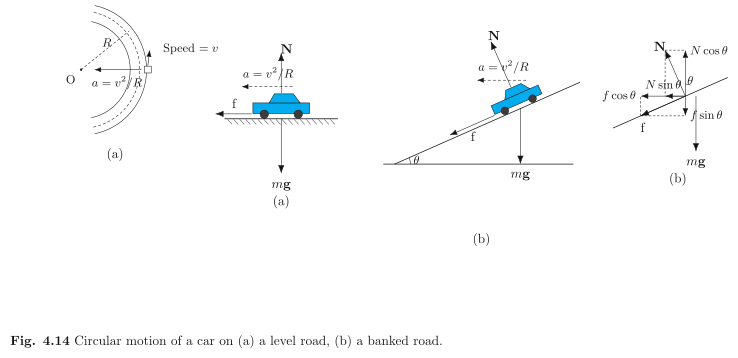
The figure places two scenarios side by side. In panel (a), a car moves on a flat, level road and follows a circular path of radius centred at . The car’s velocity is tangential to the circle, and its acceleration points radially inward toward . Two vertical forces act: the normal reaction upward and the weight downward. These cancel vertically, so they do not affect the horizontal motion. The only horizontal force is static friction , which acts toward the centre of the circle. This friction provides the necessary centripetal force.
Panel (b) shows the same car on a road that is banked at an angle to the horizontal. The normal reaction is no longer vertical — it is perpendicular to the road surface. The weight still acts straight down. Friction acts along the road surface, parallel to it. Both and are resolved into horizontal and vertical components: and for the normal, and and for friction. The horizontal components together supply the centripetal force, while the vertical components balance the weight.
The key physical idea is that banking reduces or even eliminates the need for friction to provide the centripetal force. On a level road, friction is the sole provider; on a banked road, a component of the normal reaction itself points inward, so the car can negotiate the curve at a certain “design speed” even if the road is icy (friction zero).
Here is the mass of the car, its speed, the radius of the circular path, the banking angle, the normal reaction, and the static friction (which can be at most , where is the coefficient of static friction). The first equation is the horizontal (centripetal) force balance; the second is the vertical force balance. …