Physics · Ch 4 — Laws of Motion
Newton's First Law of Motion
Newton's First Law of Motion
4.4 Newton’s First Law of Motion
From Galileo to Newton
The story of the first law begins with Galileo’s demolition of the Aristotelian view that a force is needed to keep a body in motion. Aristotle had taught that the natural state of all earthly objects is rest, and that motion requires a continuous push or pull. Galileo saw through this by imagining a ball rolling down one incline and up another: the smoother the surfaces, the closer the ball gets to its original height. If friction could be eliminated entirely, the ball would rise to exactly the same height — and if the second incline were made horizontal, the ball would roll forever at constant speed. The natural state of a body, Galileo concluded, is not rest but uniform motion in a straight line. This insight is the law of inertia.
Newton took Galileo’s law of inertia and made it the first of his three laws of motion, the foundation of all classical mechanics.
Newton’s First Law of Motion (the Law of Inertia)
Every body continues in its state of rest or of uniform motion in a straight line unless compelled by an external force to change that state.
What the First Law Really Says
The law makes two equivalent statements:
- If no net external force acts on a body, its acceleration is zero.
- If a body has zero acceleration (it is either at rest or moving with constant velocity in a straight line), the net external force on it must be zero.
Both rest and uniform linear motion are states of zero acceleration. So the first law can be written compactly as:
Conversely, acceleration can be non-zero only when a net external force acts on the body.
Two Ways the Law Is Used in Practice
Situation 1: We know the forces are zero — we deduce the motion
When we are certain that no net external force acts on an object, the first law tells us its acceleration must be zero. A spaceship far out in interstellar space, with all rockets off and no nearby stars, experiences negligible gravitational pull. The net force on it is zero. Therefore its acceleration is zero: if it is moving, it continues with the same velocity (same speed and same direction) forever.
Situation 2: We know the motion is unaccelerated — we deduce the forces are balanced
More often, we do not know all the forces acting. But if we observe that an object is at rest or moving with constant velocity, the first law forces us to conclude that the net external force on it must be zero. This is a logical inference, not an assumption.
A common mistake is to say: “Since the weight equals the normal force, the book is at rest.” This reverses cause and effect. The correct reasoning is: “Since the book is observed to be at rest, the net external force on it must be zero. Therefore the normal force must be equal and opposite to the weight.”
Examples of Balanced Forces on Earth
Gravity acts on every object near the Earth. Friction, air resistance, and normal forces are also usually present. When an object on Earth is at rest or moving uniformly, it is not because no forces act on it — it is because all the external forces cancel out to give a net force of zero.
A book at rest on a table
The book experiences two external forces:
- Its weight , directed downward, due to the Earth’s gravity.
- The normal force exerted upward by the table.
The normal force is a self-adjusting force: it automatically takes whatever magnitude is needed to prevent the book from penetrating the table. Because we observe the book at rest, we know its acceleration is zero. From the first law, the net external force must be zero:
A car moving with uniform velocity on a straight road
Consider a car that starts from rest, accelerates to some speed, and then continues on a smooth straight road at constant velocity.
- While stationary, the net force is zero.
- During the acceleration phase, a net external force must act. The only plausible external force along the road is friction between the tyres and the road. (Internal forces — forces between parts of the car itself — cannot accelerate the car as a whole; they cancel in pairs.)
- Once the car moves with constant velocity, the net external force is again zero. The forward force from the engine (transmitted through friction) is exactly balanced by resistive forces like air drag and rolling friction.
It is the frictional force from the road that accelerates a car forward. The engine turns the wheels, the wheels push backward on the road, and the road pushes forward on the wheels. That forward push is friction, and it is an external force on the car.
Inertia in Everyday Life: The Bus Jerk
The property of inertia — the tendency of a body to resist any change in its state of motion — is dramatically illustrated when a bus starts or stops suddenly.
When the bus starts suddenly
You are standing in a stationary bus. The driver starts abruptly. Your feet, in contact with the floor, experience friction. If the acceleration is moderate, friction is enough to accelerate your feet forward along with the bus. But your body is not a rigid object — it is deformable, allowing relative motion between different parts. The rest of your body, due to inertia, tends to remain where it was. Relative to the bus, you are thrown backward. Muscular forces then act to bring your whole body into motion with the bus.
When the bus stops suddenly
Your feet stop because friction prevents them from sliding forward on the floor. But the rest of your body continues moving forward due to inertia. You are thrown forward. Again, muscular forces restore your body to rest relative to the bus.
In both cases, the key is that different parts of your body can move relative to each other. If you were a perfectly rigid block, your whole body would accelerate or decelerate uniformly with the bus, and you would feel no jerk. …
Drawn by us to help you understand the concept clearly, and verified to make sure it's accurate. For exams, practice from your textbook's own diagram.
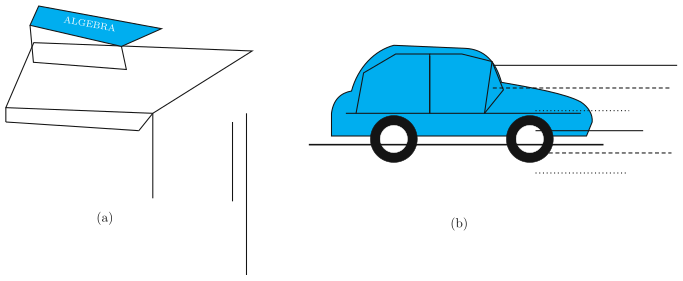
This figure is the textbook’s first visual argument for Newton’s First Law of Motion. It shows two completely different situations — a book on a table and a car on a road — and makes the claim that, in terms of net force, they are identical.
Panel (a) is straightforward: a book sits at rest on a table. The drawing uses perspective to show the table’s surface and the book’s thickness, but the physics is simple. Two forces act on the book: its weight (downward, due to gravity) and the normal force from the table (upward). Because the book is not accelerating, these two forces must cancel exactly: . The net force is zero.
Panel (b) is the more interesting case. A car moves on a horizontal road, and motion lines behind it indicate that it is travelling with uniform velocity — constant speed in a straight line. The car is not accelerating. On a real road, a moving car experiences friction, air resistance, and the forward push from its engine. Yet the figure’s caption insists that the net force on the car is also zero. How can that be? The engine’s forward force must be exactly balanced by the total resistive forces (friction + drag). The car’s velocity is constant, so its acceleration is zero, and by Newton’s Second Law, zero acceleration means zero net force.
The core lesson: A body moving with constant velocity is in the same force state as a body at rest. Both have zero net force. Motion itself does not require a net force — only change in motion does.
The textbook uses this figure to introduce the concept of inertia and to state Newton’s First Law: an object at rest stays at rest, and an object in uniform motion stays in uniform motion, unless acted upon by an external unbalanced force. The figure makes the second part of that law concrete — the car is “in uniform motion” and no net force acts on it.
The key formula that emerges from this discussion is Newton’s Second Law, which quantifies the relationship between net force and acceleration:
Here:
- is the vector sum of all forces acting on the body (the net force).
- is the mass of the body (a scalar measure of its inertia).
- is the acceleration of the body (the rate of change of velocity). …