Physics · Ch 9 — Mechanical Properties of Fluids
Atmospheric Pressure and Gauge Pressure
Atmospheric Pressure and Gauge Pressure
The Idea of Pressure
A sharp needle pressed into the skin pierces it easily, while a blunt spoon pressed with the same force does not. An elephant stepping on a man’s chest would crack his ribs, yet a circus performer can lie on a bed of nails without injury. The difference in each case is not the force applied, but how that force is distributed over the area of contact.
When force is concentrated over a tiny area, the effect is intense. When the same force is spread over a large area, the effect is mild. This leads to the definition of pressure — the normal force per unit area.
Here is the component of force acting perpendicular (normal) to the surface, and is the area over which the force is distributed. Pressure is a scalar quantity — it has magnitude but no direction. The SI unit of pressure is the pascal (Pa), where .
A common mistake is to think pressure is a vector because force is a vector. Pressure is defined as the magnitude of the normal force per unit area — it has no direction associated with it. The force on a surface element is , where is the unit normal to the surface; the pressure itself is just the scalar .
Atmospheric Pressure
The atmosphere surrounding the Earth exerts pressure on every surface in contact with it. This is called atmospheric pressure, denoted by . At sea level, the standard value is:
This is also known as 1 atmosphere (1 atm). In other common units:
The value comes from the classic experiment by Torricelli, where a column of mercury in a tube, inverted in a dish of mercury, stands at a height of about 76 cm at sea level. The pressure exerted by this mercury column exactly balances the atmospheric pressure pushing up on the mercury in the dish.
The exact value of atmospheric pressure varies with altitude, weather conditions, and temperature. The standard value is a reference point, not a constant everywhere on Earth.
Properties of Fluid Pressure
The textbook lists several key properties of pressure in a fluid at rest. Each one is derived from the fundamental definition and the condition of equilibrium.
›Proof
Property 1: Pressure is the same in all directions in a fluid at rest.
Consider a tiny, wedge-shaped element of fluid at rest, with dimensions , , and (the wedge has a sloping face of length ). The wedge is so small that the pressure can be taken as uniform over each face. Let , , and be the pressures on the faces perpendicular to the -axis, -axis, and the sloping face respectively. The forces on the wedge are:
- On the face perpendicular to : (acting in the direction)
- On the face perpendicular to : (acting in the direction)
- On the sloping face: (acting normal to the sloping face)
- The weight of the fluid element: (acting vertically downward)
For equilibrium, the net force in the -direction must be zero. The -component of is . From the geometry of the wedge, . So the -component of is . The force acts in the direction (it pushes the wedge to the left). Therefore:
This gives .
Similarly, for equilibrium in the -direction, the -component of is . From geometry, , so this component is . The force acts in the direction. The weight also has a component in the -direction? No — weight acts vertically, and in our coordinate system, is horizontal. So the -direction equilibrium is:
This gives .
Since and , we have . The choice of orientation of the wedge was arbitrary, so the pressure at a point in a static fluid is the same in all directions.
›Proof
Property 2: In a fluid at rest, the pressure is the same at all points on the same horizontal level.
Consider two points A and B at the same height in a static fluid. Imagine a small cylindrical element of fluid connecting them, with its axis horizontal. The only horizontal forces on this cylinder are the pressure forces on its two end faces. For the cylinder to be in equilibrium (no horizontal acceleration), these forces must be equal and opposite. Therefore, the pressure at A must equal the pressure at B. This holds for any two points at the same depth in a continuous, static fluid.
›Proof
Property 3: Pressure varies with depth in a fluid.
Consider a cylindrical column of fluid of height and cross-sectional area , extending from the free surface (where pressure is , usually atmospheric pressure) down to a depth . The forces acting on this column are: …
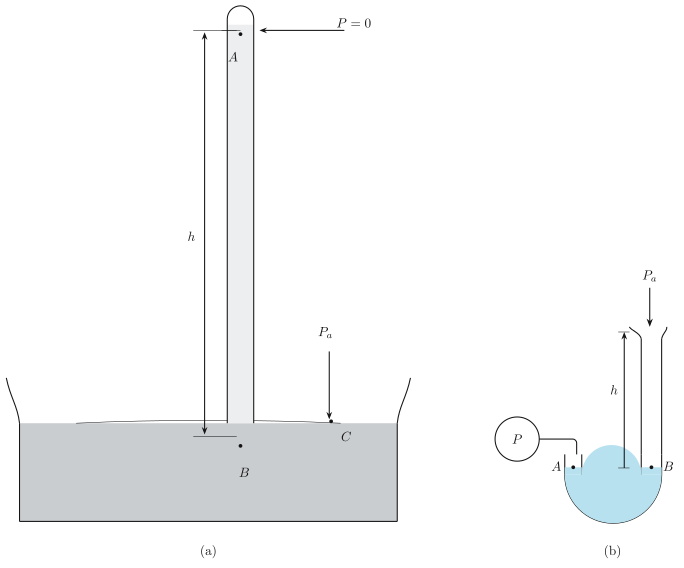
Drawn by us to help you understand the concept clearly, and verified to make sure it's accurate. For exams, practice from your textbook's own diagram.
Figure 9.5 places two classic pressure-measuring instruments side by side: the mercury barometer and the open-tube manometer. Both rely on the same core idea — a column of liquid balances an unknown pressure — but they answer different questions. The barometer measures atmospheric pressure; the manometer measures the pressure of a gas in a container relative to the atmosphere.
Panel (a) — The mercury barometer. A long glass tube, sealed at one end, is filled completely with mercury and then inverted into a trough of mercury. The mercury column drops until the pressure at the top of the column (point A) is essentially zero — a near-vacuum. At the bottom of the column, point B is at the mouth of the tube, level with the free surface of the mercury in the trough (point C). The free surface C is open to the atmosphere, so the pressure there is . The column height is the vertical distance from the trough surface to the top of the mercury inside the tube.
The physics is a simple hydrostatic balance. The pressure at point B (inside the tube, at the same horizontal level as C) must equal the pressure at C, because in a static fluid the pressure is the same at all points on the same horizontal level. At B, the pressure is due only to the weight of the mercury column above it — the vacuum at A contributes nothing. Therefore:
where is the density of mercury, is the acceleration due to gravity, and is the column height. At sea level, of mercury. This is the standard barometer equation: atmospheric pressure is directly proportional to the height of the mercury column it supports.
The pressure at the top (point A) is not exactly zero — it is the vapour pressure of mercury, which is tiny at room temperature (about ). For all practical purposes in Class 11, treat it as zero.
Panel (b) — The open-tube manometer. A U-shaped tube contains mercury. One arm (left) is connected to a bulb or container whose pressure we want to measure. The other arm (right) is open to the atmosphere, so the pressure at the free surface on that side is . The mercury levels differ by a height : the column is higher on the side with lower pressure.
Again, use the principle that pressure is the same at all points on the same horizontal level in a connected static fluid. Choose the horizontal level that passes through the lower mercury surface in the open arm (point B). On the open side, the pressure at B is just . On the left side, at the same level, the pressure is (the gas pressure in the bulb) plus the pressure due to the extra height of mercury above that level:
The sign of matters. If the gas pressure is greater than atmospheric, the mercury is pushed down on the left and up on the right — then is positive and . If the gas pressure is less than atmospheric, the mercury rises on the left and falls on the right — then is negative and . The manometer thus gives the gauge pressure (the difference from atmospheric) directly as .
…