Physics · Ch 9 — Mechanical Properties of Fluids
Variation of Pressure with Depth
Variation of Pressure with Depth
The Core Idea: Why Depth Matters
When you swim to the bottom of a pool, you feel a pressure in your ears. That sensation is the weight of the water above you pressing down. The deeper you go, the more water is stacked on top, and the greater the pressure. This is the fundamental idea behind the variation of pressure with depth: pressure in a fluid at rest increases linearly with depth.
This happens because every layer of fluid must support the weight of all the fluid above it. The effect is not just a curiosity — it explains why dams are built thicker at the base, why a bubble rises, and why a ship floats.
Deriving the Pressure-Depth Relation
Consider a fluid at rest in a container. Imagine a small, flat, horizontal area at a depth below the free surface of the fluid. The fluid above this area is a vertical column of height and cross-sectional area .
The forces acting on this column are:
- Weight of the fluid column acting downward: , where is the density of the fluid (assumed constant) and is the acceleration due to gravity.
- Force due to the pressure at the top of the column (the free surface). If the pressure at the free surface is (usually atmospheric pressure), this force is , acting downward.
- Force due to the pressure at the bottom of the column (at depth ). Let this pressure be . The force is , acting upward.
Since the fluid is at rest, the column is in equilibrium. The net vertical force must be zero:
Cancelling the area from every term gives the central result:
This equation tells you that the absolute pressure at a depth in a fluid of constant density is the sum of the pressure at the surface and the pressure due to the weight of the fluid column above, .
This formula assumes the fluid density is constant. For gases, density changes significantly with pressure, so this simple linear relation does not hold for large heights. For liquids, which are nearly incompressible, it is an excellent approximation.
Key Consequences and Properties
From this single equation, several important properties follow. The textbook lists them explicitly, and each one is a direct logical consequence of .
Property (I): Pressure is the same at all points at the same depth in a fluid at rest.
Proof: Consider two points A and B at the same depth in a fluid at rest. The pressure at A is . The pressure at B is . Since , , , and are identical for both points, . The pressure does not depend on the horizontal position — only on the vertical depth.
This is why a liquid seeks its own level in connected vessels. If you have a U-shaped tube, the pressure at the bottom of both arms must be equal for equilibrium, which forces the liquid heights to be equal.
Property (II): The pressure at a point in a fluid at rest is the same in all directions.
This is a more subtle point. The derivation above considered only the vertical direction. But what about sideways forces? Imagine a tiny cube of fluid at rest. The forces on its vertical faces must also balance, otherwise the cube would accelerate sideways. The only way this can happen is if the pressure pushing on the left face is exactly equal to the pressure pushing on the right face. Since the cube is infinitesimally small, these faces are at essentially the same depth, so Property (I) already guarantees this. The result is that pressure acts equally in every direction at a given point.
This is known as Pascal's law in its simplest form: a change in pressure applied to an enclosed fluid is transmitted undiminished to every portion of the fluid and to the walls of its container. This property is the foundation of hydraulic lifts and brakes.
Property (III): The pressure difference between two points in a fluid depends only on the vertical separation between them.
Proof: Let point 1 be at depth and point 2 be at depth , with . Then:
Subtracting:
The pressure difference depends only on the vertical separation , not on the horizontal distance between the points. This is why a manometer (a U-tube filled with a liquid) can measure pressure differences by simply reading the height difference of the liquid columns.
When solving problems, always measure depth from the free surface. If the free surface is open to the atmosphere, is atmospheric pressure (). If the container is sealed and the space above the liquid is evacuated, (gauge pressure then equals absolute pressure).
Gauge Pressure vs. Absolute Pressure
In many practical situations, you care about the pressure relative to the atmosphere. For example, a car tyre gauge reads zero when the tyre is open to the air. This reading is called gauge pressure:
The absolute pressure is the total pressure, including the atmosphere:
…
Drawn by us to help you understand the concept clearly, and verified to make sure it's accurate. For exams, practice from your textbook's own diagram.
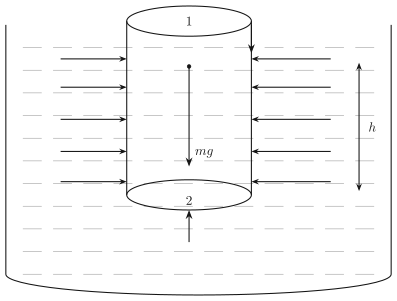
Fig. 9.3 is a free-body diagram of a small, imaginary cylinder of fluid sitting vertically inside a larger body of fluid at rest. The cylinder has cross-sectional area and height . Its top face (point 1) is at a higher level than its bottom face (point 2). The figure isolates this cylinder to show the forces that keep it in equilibrium under gravity.
The diagram marks three sets of forces. First, the cylinder’s own weight acts straight downward through its centre. Second, the surrounding fluid pushes inward on the curved side walls — these are the horizontal arrows pointing toward the cylinder from left and right. Because these side forces are horizontal and symmetric, they cancel each other out and play no role in the vertical balance. Third, and most important, are the vertical pressure forces on the flat top and bottom faces: a downward force at the top (pressure times area ) and an upward force at the bottom (pressure times area ). The height is labelled on the right side of the cylinder.
The physical idea is simple: the fluid cylinder is at rest, so the net vertical force on it must be zero. The upward force from the bottom must exactly balance the downward forces from the top and from the weight. This gives the equilibrium condition:
The mass of the cylinder is its density times its volume , so . Substituting and dividing through by yields the central result:
Here is the pressure at the lower point, the pressure at the higher point, the density of the fluid (assumed uniform), the acceleration due to gravity, and the vertical separation between the two points. The formula shows that pressure in a static fluid increases linearly with depth — every metre you go down adds to the pressure.
The height in this formula is the vertical distance, not the slant distance along a pipe or slope. Only the vertical drop matters for the pressure difference. …
Drawn by us to help you understand the concept clearly, and verified to make sure it's accurate. For exams, practice from your textbook's own diagram.
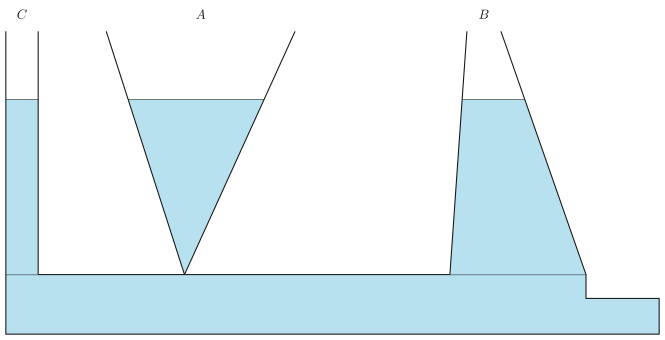
The figure shows three vessels — let us call them A, B and C — all connected at the bottom by a horizontal tube. Vessel A is a thin tube leaning to one side, vessel B is an upward-tapering cone (wider at the top than at the bottom), and vessel C is a wide funnel (narrow at the bottom, flaring out). Despite their wildly different shapes and the fact that they contain very different volumes of liquid, the liquid stands at exactly the same height in all three. This is the hydrostatic paradox: the pressure at the bottom of each vessel depends only on the vertical height of the liquid column, not on the shape or the total amount of liquid.
The physical idea is straightforward. In a static fluid, the pressure at any point is determined by the weight of the fluid column directly above that point. For a point at the bottom of any of these vessels, the vertical distance to the free surface is the same — call it . The pressure at the bottom is therefore , where is the atmospheric pressure at the free surface, is the density of the liquid, and is the acceleration due to gravity. This formula contains no factor for the shape of the vessel or the total volume of liquid. The bottom pressure is identical in all three vessels because is identical.
A common mistake is to think that the vessel with more liquid exerts more pressure at the bottom. The hydrostatic paradox shows this is false: the pressure depends only on height, not on the total weight of the liquid. The extra liquid in the wide funnel is supported by the sloping walls, not by the bottom.
The horizontal connecting tube ensures that the pressure at the bottom of each vessel is the same — if it were not, liquid would flow from the higher-pressure region to the lower-pressure one until equilibrium is reached. That equilibrium is exactly what the figure shows: all three columns settle at the same height.
…