Q.Find the magnitude and direction of the resultant of two vectors and in terms of their magnitudes and angle between them.
You're viewing a preview — the full solution, concept, methods & PYQ mapping are locked.
Start your 14-day free trial to unlock the full solution →The resultant of two vectors is found by placing them head-to-tail and applying the law of cosines for magnitude and the law of sines for direction. The magnitude is , and the direction is given by , where is the angle the resultant makes with .
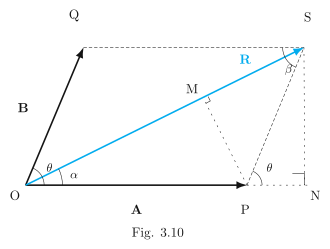
Figure 3.10 shows the construction this derivation is built on: and represent and at angle to each other, and the parallelogram's diagonal represents the resultant . Dropping the perpendicular onto the extended line (meeting it at , with perpendicular to ) turns the geometry into the right triangles used below to derive 's magnitude and its direction from .
When you add two vectors, you're combining their effects. The key insight is that vectors don't add like plain numbers — direction matters. If you walk 5 km east and then 5 km north, you end up 7.07 km northeast, not 10 km. That's the whole story in a nutshell.
The most natural way to add vectors is the head-to-tail method: place the tail of at the head of , then draw the resultant from the tail of to the head of . This creates a triangle, and the problem reduces to solving that triangle.
1. Set up the triangle
Let and have magnitudes and , with an angle between them. When you place them head-to-tail, the angle inside the triangle at the vertex where starts is not — it's . Why? Because is the angle between the vectors when they share a tail. Once you shift to the head of , the interior angle becomes supplementary to .
A very common mistake is to use directly in the law of cosines. The interior angle of the triangle is , and . This sign flip is crucial.
2. Find the magnitude using the law of cosines
In any triangle with sides , , and , where is opposite the angle , the law of cosines gives:
Since , this becomes:
This is the magnitude of the resultant. Notice the plus sign — it comes from the fact that when is small (vectors nearly aligned), is large and positive, so is close to . When , , and you get the Pythagorean theorem: . When (opposite directions), , and , the minimum possible.
3. Find the direction …
Unlock everything free for 14 days
- Full step-by-step solutions
- Concept-first explanations
- Methods, shortcuts & mistakes
- PYQ mapping + timed mock tests
Full access for 14 days. No credit card required.