Physics · Ch 13 — Oscillations
Velocity and Acceleration in Simple Harmonic Motion
Velocity and Acceleration in Simple Harmonic Motion
Velocity and Acceleration in Simple Harmonic Motion
When a particle executes simple harmonic motion, its position changes sinusoidally with time. From that single fact, we can derive everything about how fast it moves and how it accelerates. The key is to start with the displacement function and then differentiate — once for velocity, once for acceleration.
The standard equation for displacement in SHM is:
Here is the amplitude, is the angular frequency, and is the initial phase. We will use this form throughout, but the same results hold for a sine function with a different phase constant.
Velocity in SHM
Velocity is the rate of change of displacement with time. Differentiate :
Using the chain rule, the derivative of is , and the derivative of the argument is . So:
This is the instantaneous velocity at any time . Notice that the velocity also varies sinusoidally, but it is (or radians) out of phase with the displacement — when displacement is maximum, velocity is zero, and vice versa.
A useful alternative form relates velocity directly to displacement, without time. Use the identity . From , we have . Then . Substituting into gives:
The sign tells you the direction of motion: positive when moving away from the mean position in the positive direction, negative when moving back.
This expression is extremely useful. It shows that speed is greatest when (at the mean position) and zero when (at the extreme positions).
Acceleration in SHM
Acceleration is the rate of change of velocity. Differentiate :
The derivative of is , and again the chain rule brings down a factor of :
But is just . Therefore:
This is the defining relation of simple harmonic motion: acceleration is directly proportional to displacement from the mean position and always directed towards it (the negative sign indicates that acceleration and displacement are opposite in direction).
The equation is the signature of SHM. If you ever see a system where acceleration is proportional to negative displacement, you know it oscillates with angular frequency .
Properties of Velocity and Acceleration in SHM
The textbook lists three key properties that summarise the behaviour. Each follows directly from the equations above.
Property 1: At the mean position ()
- Displacement is zero.
- Velocity is maximum: . (From .)
- Acceleration is zero: .
The particle is moving fastest as it passes through the centre, and there is no restoring force there.
Property 2: At the extreme positions ()
- Displacement is maximum.
- Velocity is zero: .
- Acceleration is maximum: . The magnitude is .
At the turning points, the particle momentarily stops before reversing direction. The restoring force (and hence acceleration) is strongest here.
Property 3: The phase relationship
- Displacement varies as .
- Velocity varies as , which is the same as .
- Acceleration varies as , which is the same as .
So velocity leads displacement by a phase of (a quarter cycle), and acceleration leads displacement by (half a cycle) — meaning acceleration is exactly opposite in phase to displacement.
A common mistake is to think that because , acceleration is always negative when displacement is positive. That is true — but "negative acceleration" here means directed towards the mean position, not necessarily "slowing down". When the particle is moving from the mean to the positive extreme, velocity is positive but decreasing; acceleration is negative. When it returns from the positive extreme to the mean, velocity is negative and increasing (becoming less negative); acceleration is still negative. Always think of acceleration as the restoring influence, not as "speeding up" or "slowing down".
A Complete Table of Instantaneous Values
For a quick reference, here are the three quantities at key points in the cycle, assuming (i.e., for simplicity):
| Time | Displacement | Velocity | Acceleration |
|---|---|---|---|
Drawn by us to help you understand the concept clearly, and verified to make sure it's accurate. For exams, practice from your textbook's own diagram.
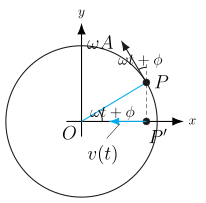
The figure places a reference circle of radius on a standard - coordinate plane. A particle moves uniformly around this circle with constant angular speed . Its position on the circle is given by the angle measured from the positive -axis, where is the initial phase. The foot of the perpendicular from onto the -axis is labelled — this is the point that executes simple harmonic motion along the -axis.
The key physical idea is that the velocity of is not the full velocity of , but only its -component. The particle has a tangential velocity of magnitude , shown as an indigo arrow tangent to the circle at . This velocity vector makes the same angle with the horizontal as the radius vector does. The projection of this indigo arrow onto the -axis is drawn as a blue arrow at the foot — that blue arrow represents , the instantaneous velocity of the SHM oscillator.
From the geometry, the magnitude of the tangential velocity is . Its -component is with a sign determined by direction. But careful: the velocity of is the rate of change of its displacement . Differentiating gives . The figure's projection gives only when the angle is measured from the -axis in the standard way — the sign difference arises because the projection of the tangential vector onto is , while the actual SHM velocity is . These two expressions are related by a phase shift of : .
A common mistake is to read the projected arrow directly as without accounting for the sign. The figure shows the geometric projection of the tangential velocity, but the actual SHM velocity formula picks up a negative sign because the derivative of cosine is negative sine. Always check the direction: when is in the first quadrant, its tangential velocity has a negative -component (pointing left), so is negative — consistent with being negative for small positive angles.
The textbook uses this figure to derive the central velocity relation for SHM:
Here is the amplitude (radius of the reference circle), is the angular frequency, is time, and is the initial phase. The magnitude of the maximum velocity is , which occurs when — that is, when the particle crosses the -axis and its tangential velocity is entirely horizontal. …
Drawn by us to help you understand the concept clearly, and verified to make sure it's accurate. For exams, practice from your textbook's own diagram.
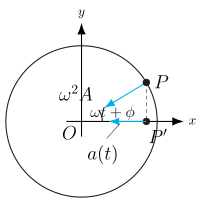
The figure shows two linked pictures side by side. On the left is the reference circle — a circle of radius centred at . A particle moves on this circle with uniform angular speed . Its position is marked by the radius vector making an angle with the positive -axis. The foot of the perpendicular from onto the horizontal diameter is labelled — this is the particle executing simple harmonic motion along the -axis.
On the right is the acceleration diagram. The centripetal acceleration of is a vector of magnitude directed radially inward toward . In the figure this vector is drawn in indigo (or a distinct colour) from toward . Its -component is the projection onto the horizontal line through : that component is , and it is shown as a blue arrow at the foot . The sign is negative because the acceleration always points opposite to the displacement — toward the equilibrium position .
The physical idea is beautifully simple: the acceleration of the SHM particle is exactly the horizontal projection of the centripetal acceleration of the uniform circular motion of . Because moves at constant speed, its acceleration has constant magnitude and always points to the centre. Only the -component of that vector changes with time, and that changing component is precisely the acceleration of the SHM.
From this geometric picture the textbook derives the central formula for acceleration in SHM:
where is the displacement of from , is the angular frequency of the motion, and is the amplitude. The negative sign tells you that acceleration is always directed opposite to displacement — toward the equilibrium position. This is the hallmark of simple harmonic motion: the restoring force (and hence acceleration) is proportional to the negative of the displacement. …
Drawn by us to help you understand the concept clearly, and verified to make sure it's accurate. For exams, practice from your textbook's own diagram.
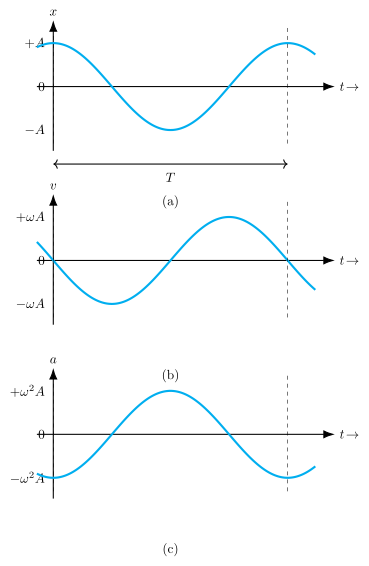
The figure stacks three graphs on the same time axis, letting you see how position, velocity, and acceleration evolve together for a particle executing simple harmonic motion (SHM). Each graph shares the same horizontal axis — time — and the same period , but the curves are shifted relative to one another.
Top panel (a): displacement .
The curve is a cosine wave: . The vertical axis runs from to , where is the amplitude. At , the particle is at its maximum positive displacement . It then moves toward the equilibrium position (), reaches the negative extreme at , and returns to at .
Middle panel (b): velocity .
The velocity is the time derivative of displacement:
The vertical scale now runs from to . The curve is a negative sine wave — it starts at zero (since ), becomes negative as the particle moves leftward from , reaches its most negative value at , crosses zero again at (when the particle is at and momentarily stops), then becomes positive as the particle moves rightward back toward .
Bottom panel (c): acceleration .
Acceleration is the derivative of velocity (or the second derivative of displacement):
The vertical scale runs from to . This is a negative cosine wave — it starts at (maximum negative acceleration) when the particle is at , passes through zero at (when the particle is at equilibrium), reaches at (when the particle is at ), and so on.
All three quantities have the same period , but they are out of phase. Velocity lags displacement by (a quarter-cycle), and acceleration is exactly opposite in phase to displacement — they differ by (half a cycle). This is why the acceleration is proportional to , the defining signature of SHM.
The key relation that ties the three panels together is the restoring force law:
Since for a spring-mass system, this is equivalent to . The figure makes this physically vivid: whenever the displacement is largest (at the extremes), the acceleration is also largest but in the opposite direction; whenever the particle whips through equilibrium (), the acceleration is zero and the speed is maximum.
To quickly sketch these curves from memory: start with the cosine displacement. The velocity is the negative sine — it crosses zero where displacement peaks, and peaks where displacement crosses zero. The acceleration is just the displacement flipped upside down and scaled by . …