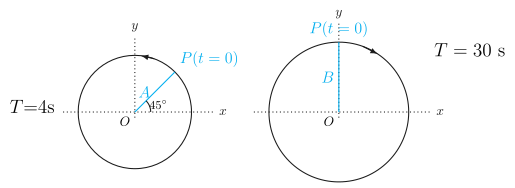
Q.The figure given below depicts two circular motions. The radius of the circle, the period of revolution, the initial position and the sense of revolution are indicated in the figures. Obtain the simple harmonic motions of the -projection of the radius vector of the rotating particle P in each case. Motion (a): a circle of radius , period of revolution s. At the particle P is at an angle of above the positive -axis, and it revolves in the anticlockwise sense. Motion (b): a circle of radius , period of revolution s. At the particle P is at the topmost point of the circle, on the positive -axis, and it revolves in the clockwise sense.
You're viewing a preview — the full solution, concept, methods & PYQ mapping are locked.
Start your 14-day free trial to unlock the full solution →Write the position vector's angle with the -axis as a function of time, then take
its -projection . Case (a): , SHM of period 4 s. Case (b): , SHM of period 30 s.
Why This Approach Works
When a particle P moves uniformly on a circle of radius with angular speed
, its position vector makes an angle with the -axis that
changes linearly with time. The -projection of P, , then
automatically executes SHM — this is exactly the reference-circle connection between
uniform circular motion and SHM developed in this section. The only work needed per
case is to write down correctly from the given initial angle, period, and
sense of rotation (clockwise subtracts from the initial angle; anticlockwise adds to
it).
Step-by-Step Solution
Case (a): radius , s, initial angle , anticlockwise.
The angular speed is .
Since the motion is anticlockwise, the angle with the -axis increases with time:
The -projection is therefore
This is SHM of amplitude , angular frequency rad/s (period 4 s), and
initial phase .
Case (b): radius , s, initial angle (on the -axis), clockwise.
The angular speed is . …
Unlock everything free for 14 days
- Full step-by-step solutions
- Concept-first explanations
- Methods, shortcuts & mistakes
- PYQ mapping + timed mock tests
Full access for 14 days. No credit card required.