Computer Science · Ch 11 — Data Communication
Wireless Transmission Media
Wireless Transmission Media
Wireless transmission media use electromagnetic signals that travel through the air, not through any physical cable. The entire usable range of frequencies for this purpose — from 3 KHz to 900 THz — is called the electromagnetic spectrum. This spectrum is divided into four broad categories: radio waves, microwaves, infrared waves, and visible (light) waves. Of these four, three are practically useful for data communication.
Radio Waves (3 KHz – 1 GHz)
Radio waves are the lowest-frequency waves in the wireless spectrum. They are omni-directional — they spread out in all directions from the source, so the sending and receiving antennas do not need to be aligned.
- Waves in the 300 KHz to 30 MHz range can travel very long distances.
- Waves in the 3 KHz to 300 KHz range can penetrate solid walls.
- Radio waves are susceptible to interference from other signals and electrical noise.
- Common uses: AM and FM radio, television broadcasting, and cordless phones.
Microwaves (1 GHz – 300 GHz)
Microwaves are higher-frequency waves that behave very differently from radio waves. They are unidirectional — they travel in a single straight line, like a beam.
- They cannot penetrate solid obstacles such as walls, hills, or mountains.
- Communication requires line-of-sight propagation: the transmitting and receiving antennas must be directly facing each other, with no obstruction in between.
- Because of their directionality, microwaves are ideal for point-to-point (or unicast) communication — for example, radar systems and satellite links.
- They offer a very large information-carrying capacity, meaning they can transmit a lot of data quickly.
Geostationary satellites orbiting Earth use microwaves to deliver broadband Internet service. A satellite dish at your home communicates with the satellite Internet provider’s hub using these waves — the same principle used for satellite television and telephone signals.
Infrared Waves (300 GHz – 400 THz)
Infrared waves have a very high frequency. Like microwaves, they cannot penetrate solid walls.
- They are used only for short-distance, point-to-point communication.
- Typical applications: connecting a mobile phone to another mobile phone, a mobile phone to a printer, a remote control to a television, and Bluetooth-enabled devices (such as a wireless mouse or keyboard) to a computer.
Visible (Light) Waves
The textbook mentions visible or light waves as the fourth category in the spectrum (400 THz – 900 THz), but notes that of the four categories, only three are useful for wireless communication. Light waves are not discussed further in this section.
Summary Table of Properties
| Transmission Wave | Frequency Range | Directionality | Can Penetrate Walls? | Key Uses |
|---|---|---|---|---|
| Radio Waves | 3 KHz – 1 GHz | Omni-directional | Yes (3–300 KHz) | AM/FM radio, TV, cordless phones |
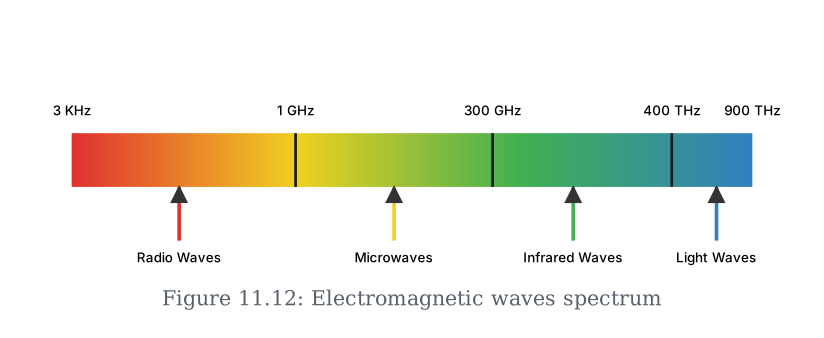
Drawn by us to help you understand the concept clearly, and verified to make sure it's accurate. For exams, practice from your textbook's own diagram.
This is the electromagnetic spectrum — the full range of wave frequencies, from the lowest (Radio Waves, around 3 KHz) to the highest (Light Waves, up to 900 THz) shown here. As frequency increases moving right along the bar, the waves carry more energy and behave differently. …
| Transmission Waves | Properties |
|---|---|
| Radio Waves | 1. Waves of frequency range 3 KHz - 1 GHz 2. Omni-directional, these waves can move in all directions 3. Radio waves of frequency 300KHz-30MHz can travel long distance 4. Susceptible to interference 5. Radio waves of frequency 3-300KHz can penetrate walls 6. These waves are used in AM and FM radio, television, cordless phones. |
| Microwaves | 1. Electromagnetic waves of frequency range 1GHz - 300GHz. 2. Unidirectional, can move in only one direction. 3. Cannot penetrate solid objects such as walls, hills or mountains. 4. Needs line-of-sight propagation i.e. both communicating antenna must be in the direction of each other. 5. Used in point-to-point communication or unicast communication such as radar and satellite. 6. Provide very large information-carrying capacity. |