Physical Education · Ch 1 — Management of Sporting Events
Procedure to Draw Combination Fixture
Procedure to Draw Combination Fixture
A combination fixture blends the knock-out and league formats, following the same steps used for each. The most common form is the League-Knock-Out: the teams first play a full league, and the top teams from the league table then move into a knock-out stage. The worked example below uses 8 teams.
- Number of teams = 8
- League matches = 8(8 - 1) / 2 = 56 / 2 = 28
- Rounds in the league = 7
The league round-by-round pairings (team 8 kept fixed, the rest rotating by the cyclic method) are:
| Round 1 | Round 2 | Round 3 | Round 4 | Round 5 | Round 6 | Round 7 |
|---|---|---|---|---|---|---|
| 1-8 | 7-8 | 6-8 | 5-8 | 4-8 | 3-8 | 2-8 |
| 2-7 | 1-6 | 7-5 | 6-4 | 5-3 | 4-2 | 3-1 |
| 3-6 | 2-5 | 1-4 | 7-3 | 6-2 | 5-1 | 4-7 |
| 4-5 | 3-4 | 2-3 | 1-2 | 7-1 | 6-7 | 5-6 |
After the league, points are totalled (Win = 5, Draw = 3, Loss = 0) and the teams are ranked. The top four teams qualify (marked Q) for the knock-out stage.
| S. No. | Team | Matches Played | Won | Lost | Drawn | Total Points | Ranking |
|---|---|---|---|---|---|---|---|
| 1 | 1 | 7 | 5 | 2 | 0 | 25 | I (Q) |
| 2 | 2 | 7 | 2 | 3 | 2 | 16 | V |
| 3 | 3 | 7 | 2 | 2 | 3 | 16 | V |
| 4 | 4 | 7 | 2 | 4 | 1 | 13 | VI |
| 5 | 5 | 7 | 3 | 2 | 2 | 21 | II (Q) |
| 6 | 6 | 7 | 4 | 2 | 1 | 23 | III (Q) |
| 7 | 7 | 7 | 1 | 4 | 2 | 11 | VII |
| 8 | 8 | 7 | 3 | 3 | 1 | 18 | IV (Q) |
So teams 1, 5, 6 and 8 qualify for the knock-out rounds.
Before the tournament the committee must also fix how the qualifiers are paired at the semi-finals. Here they are placed by ranking, but other patterns are equally acceptable:
- the first-ranked team plays the third and the second plays the fourth; or
- the first-ranked team plays the fourth and the second plays the third; or
- the pairings are decided by a draw of lots.
The knock-out stage of this example is shown below.
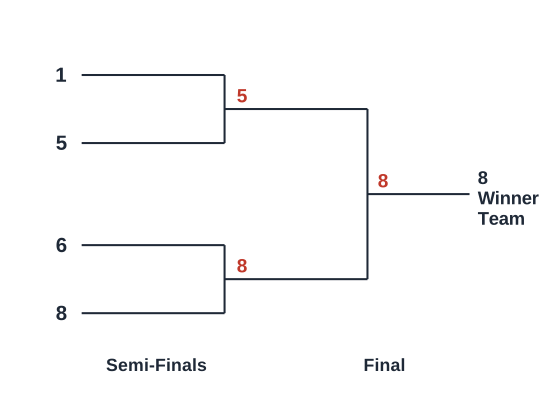
Drawn by us to help you understand the concept clearly, and verified to make sure it's accurate. For exams, practice from your textbook's own diagram.
The knock-out stage of the League-Knock-Out combination example. After the league stage the top four teams — 1, 5, 6 and 8 — qualify for the knock-outs and are drawn according to their ranking. Semi-final 1: 1 vs 5, won by 5. Semi-final 2: 6 vs 8, won by 8. Final: 5 vs 8, won by 8, so Team 8 is the champion and Team 5 the runner-up. A third-place match may be played between the two losing semi-finalists, 1 vs 6. The bracket shows how …
- First semi-final: 1 vs 5, won by 5.
- Second semi-final: 6 vs 8, won by 8.
- Final: 5 vs 8, won by 8.
- Third-place match (optional): 1 vs 6. …