Physical Education · Ch 3 — Yoga as Preventive Measure for Lifestyle Disease
Anulom-Vilom
Anulom-Vilom
Anulom-Vilom is one of the fundamental types of pranayama. It is also called Anuloma-Viloma - viloma means 'produced in the reverse order' - because the order in which the nostrils are used for inhalation and exhalation is reversed each time. It is a form of alternate-nostril breathing.
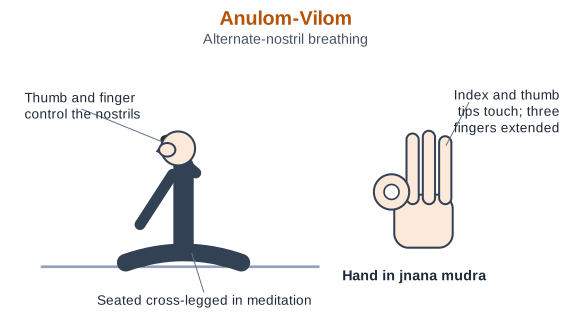
Drawn by us to help you understand the concept clearly, and verified to make sure it's accurate. For exams, practice from your textbook's own diagram.
A line drawing of a bare-torso person sitting cross-legged in a meditation posture, one hand raised to the nose with the thumb and a finger controlling the nostrils, next to a separate close-up of the hand held in jnana mudra - the al …
Technique
- Sit in any comfortable meditation asana. Keep the head and spine straight and the eyes closed.
- Place the right hand in jnana mudra. Close the right nostril with the right thumb and inhale through the left nostril for 5 counts.
- After 5 counts, release the thumb from the right nostril and close the left nostril with the ring finger.
- Exhale through the right nostril for 10 counts, keeping the breath slow, deep and silent. Then inhale through the right nostril for 5 counts.
- Continue for 5 rounds, or for 3 to 5 minutes, making sure no sound is produced as the air passes through the nostrils.
Benefits
- Calms and steadies the mind, improves focus and concentration, and balances the left and right hemispheres of the brain.
- Strengthens the immune system.
- Helps manage hypertension.
- Provides sufficient oxygen for the functioning of every cell in the body.
- Removes waste products such as carbon dioxide and other toxic gases from the body so that they do not remain in the bloodstream.
Anulom-Vilom trains slow, controlled breathing through alternate nostrils, which is why the NCERT/CBSE syllabus places this pranayama among the practices that benefit asthma and overall respiratory health.
Contraindications
- Avoid practising immediately after a meal; wait at least 2-3 hours for the stomach to settle.
- Anyone with a severe cold or blocked nostrils should wait until breathing through the nose is reasonably clear.
- People with very high, unstable blood pressure or heart conditions should practise only under guidance and avoid any forceful breath retention.
- Should be practised gently, without strain, by anyone currently experiencing breathlessness.
Why Anulom-Vilom specifically helps asthma
Breathing out for twice as long as the inhalation (a 1:2 ratio, as in the technique's 5-count inhale and 10-count exhale) is a classic technique for training the lungs to empty more completely on each breath. An asthmatic airway often traps stale air behind narrowed bronchial tubes; the longer, controlled exhalation of Anulom-Vilom helps push this trapped air out more fully, leaving more room for a fresh, effective inhalation on the next breath, complementing the chest-opening asanas (Urdhvahastottansana, Gomukhasana) elsewhere in the asthma sequence.