Biology · Ch 6 — Evolution
Origin of Life
Origin of Life
When you look at a star on a clear night, you are not seeing it as it is now. The light from that star has travelled for millions of years across trillions of kilometres before reaching your eyes. So you are, in a literal sense, looking back in time. The same principle does not apply to objects around you — you see them instantly, in the present moment. This idea of peeping into the past helps frame the biggest question in biology: how did life begin?
The origin of life is considered a unique event in the history of the universe. The universe itself is vast beyond comprehension, and Earth is, relatively speaking, almost a speck within it. Yet on this tiny speck, something extraordinary happened — life arose. That single event is the starting point of the entire story of evolution.
The textbook uses the star-gazing analogy to make one point clear: when we study the origin of life, we are trying to understand an event that happened in the deep past, not something we can observe directly in the present.
From the Big Bang to a Living Planet
Most cosmologists trace the origin of the universe to a "Big Bang" — an explosive expansion that first produced simple gases (hydrogen and helium), which later condensed under gravity into stars and galaxies. Our own Earth condensed out of leftover matter from our solar system's formation about 4.5 billion years ago.
The very young Earth had nothing like today's oxygen-rich atmosphere. Its early "reducing" atmosphere was made mostly of water vapour, methane, carbon dioxide, and ammonia. Ultraviolet radiation from the sun split some of the water vapour, and the oxygen this gradually released built up a protective ozone layer around the planet. As the Earth cooled, water vapour condensed and fell as rain, filling the ocean basins. Life itself is thought to have appeared roughly 500 million years after Earth formed — about 4 billion years ago.
Competing Ideas About How Life Began
Before science settled on a mechanism, several rival ideas tried to explain the sudden appearance of life:
- Panspermia proposed that life did not originate on Earth at all, but arrived here ready-made, as spores drifting in from outer space.
- Spontaneous generation held that living organisms could arise directly from decaying organic matter — the old belief that maggots simply appeared out of rotting meat.
Louis Pasteur experimentally disproved spontaneous generation with his sealed-flask experiments: a nutrient broth stayed free of microbes as long as it was sealed off from the air, and only grew microbes once exposed to organisms already present outside. Life, he showed, comes only from pre-existing life — at least under everyday conditions.
The idea that eventually prevailed is the Oparin-Haldane theory of chemical evolution: the first organic molecules formed from simpler inorganic ones under the harsh conditions of the early Earth — high temperature, volcanic activity, and a reducing atmosphere rich in methane and ammonia, with no free oxygen around to break the new molecules apart as fast as they formed. …
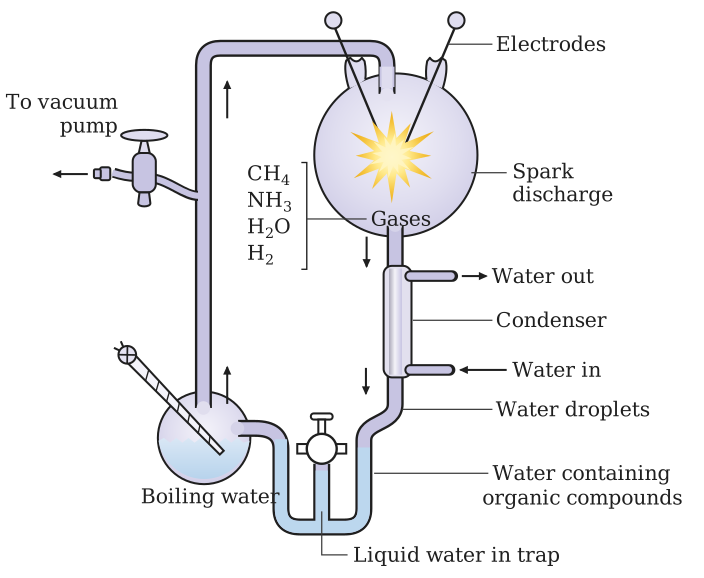
Drawn by us to help you understand the concept clearly, and verified to make sure it's accurate. For exams, practice from your textbook's own diagram.
Miller’s experiment is the classic demonstration of how organic molecules could have formed from inorganic gases under the conditions thought to exist on early Earth. Figure 6.1 in your NCERT textbook shows the apparatus he used in 1953.
The diagram is a closed, sealed glass system. On the left side, a large flask contains the “primitive atmosphere” — a mixture of methane (CH₄), hydrogen (H₂), ammonia (NH₃), and water vapour. Above this flask, two electrodes are placed, connected to a power source. Between these electrodes, a spark is shown jumping across the gap. This electric discharge mimics the lightning that would have been common in Earth’s early atmosphere.
Below the main flask, a smaller flask of water sits over a heat source (a burner). The water is boiling, producing steam that rises into the upper flask. This steam mixes with the other gases and circulates through the system.
The gases then pass through a condenser — a tube surrounded by cold water — which cools them back into liquid. The condensed liquid drips into a U-shaped trap at the bottom. This trap is the collection point. In the actual experiment, after running the apparatus for a week, Miller found that the liquid in this trap contained amino acids — the building blocks of proteins. …