Chemistry · Ch 7 — Alcohols, Phenols and Ethers
Alcohols — Mono, Di, Tri or Polyhydric Alcohols
Alcohols — Mono, Di, Tri or Polyhydric Alcohols
By the number of hydroxyl groups
Alcohols (and, in the same way, phenols) are grouped as monohydric, dihydric, trihydric, or, more generally, polyhydric, according to whether the molecule carries one, two, three, or many groups.
- Monohydric — one group, e.g. ethanol, .
- Dihydric — two groups on different carbons, e.g. ethylene glycol, .
- Trihydric — three groups on different carbons, e.g. glycerol, .
Further classification of monohydric alcohols
A monohydric alcohol can be classified further by the hybridisation of the carbon atom that carries the group.
(i) Compounds with a bond
Here the is attached to an -hybridised carbon of an alkyl group. This class splits into the following types.
Primary, secondary and tertiary alcohols — named by whether the -bearing carbon is itself attached to one, two, or three other carbon atoms:
- Primary (1°): — the hydroxyl carbon is bonded to only one other carbon.
- Secondary (2°): — the hydroxyl carbon is bonded to two other carbons.
- Tertiary (3°): — the hydroxyl carbon is bonded to three other carbons.
Allylic alcohols — the is on an -hybridised carbon that sits right next to a carbon–carbon double bond (an allylic carbon). Depending on how many other carbons are also attached to that same hydroxyl-bearing carbon, an allylic alcohol can itself be primary, secondary, or tertiary — for instance, is a primary allylic alcohol, while is a secondary allylic alcohol and is a tertiary allylic alcohol.
Benzylic alcohols — the is on an -hybridised carbon directly attached to an aromatic (benzene) ring. As with allylic alcohols, a benzylic alcohol can be primary, secondary, or tertiary depending on the number of carbon substituents on the hydroxyl-bearing carbon.
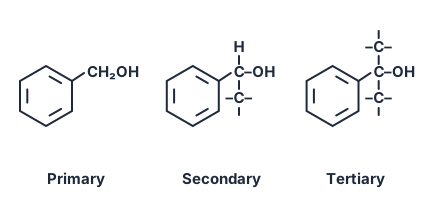
Drawn by us to help you understand the concept clearly, and verified to make sure it's accurate. For exams, practice from your textbook's own diagram.
Redrawn from the NCERT page with the structures, printed labels (CH2OH, Primary, H, C–OH, –C–, Secondary, C, –OH, Tertiary) and reagent placement exactly …
…