Chemistry · Ch 7 — Alcohols, Phenols and Ethers
Phenols — Mono, Di and Trihydric Phenols
7.1.2
Phenols — Mono, Di and Trihydric Phenols
Phenols are classified on exactly the same basis as alcohols in §7.1.1 — by how many hydroxyl groups are attached directly to the aromatic ring.
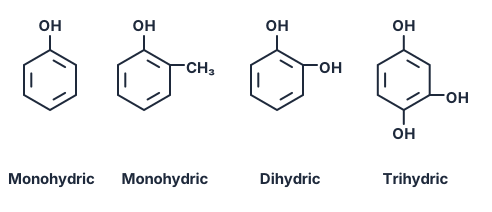
Classification of phenols by the number of hydroxyl groups on the ring, exactly as printed in the textbook — phenol and o-cresol as monohydric examples, catechol (two adjacent ring OH groups) as dihydric, and a benzene ring bearing three hydroxyl groups in the printed 1,2,4-pattern as trihydric.
Drawn by us to help you understand the concept clearly, and verified to make sure it's accurate. For exams, practice from your textbook's own diagram.
Redrawn from the NCERT page with the structures, printed labels (OH, Monohydric, CH3, Dihydric, Trihydric) and reagent placement exactly as …
- Monohydric phenols carry a single ring . The parent compound, , is simply called phenol; a ring-substituted version carrying only one , such as 2-methylphenol (common name o-cresol, with the and on adjacent ring carbons), is also monohydric.
- Dihydric phenols carry two groups on the ring, at two different ring positions — for example, benzene-1,2-diol (common name catechol), where the two hydroxyl groups sit on adjacent ring carbons.
- Trihydric phenols carry three groups on the ring, at three different ring positions. Well-known trihydric phenols include pyrogallol (benzene-1,2,3-triol) and phloroglucinol (benzene-1,3,5-triol). …