Chemistry · Ch 8 — Aldehydes, Ketones and Carboxylic Acids
Substitution Reactions in the Hydrocarbon Part
Substitution Reactions in the Hydrocarbon Part
Once a carboxyl group is present, it also influences how the rest of the hydrocarbon skeleton — the alkyl chain in an aliphatic acid, or the ring in an aromatic acid — reacts further.
1. Halogenation (Hell–Volhard–Zelinsky Reaction)
Aliphatic carboxylic acids that carry an -hydrogen (a hydrogen on the carbon directly next to ) undergo substitution of that hydrogen by a halogen on treatment with chlorine or bromine in the presence of a small amount of red phosphorus. The product is an -halocarboxylic acid. This transformation is known as the Hell–Volhard–Zelinsky (HVZ) reaction:
HVZ conditions, at a glance: the substrate must have an -hydrogen; the halogen is or ; the catalyst is a small amount of red phosphorus (which converts some of the acid to the acid halide, the species that actually undergoes enolisation and halogenation); the reaction is worked up with water; and substitution occurs specifically at the -carbon, giving an -halocarboxylic acid.
2. Ring Substitution
Aromatic carboxylic acids undergo electrophilic substitution reactions on the benzene ring. In these reactions the carboxyl group behaves as a deactivating and meta-directing substituent, so the incoming electrophile is directed predominantly to the meta position:
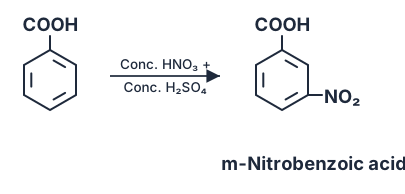
Drawn by us to help you understand the concept clearly, and verified to make sure it's accurate. For exams, practice from your textbook's own diagram.
Redrawn from the NCERT page with the structures, printed labels (COOH, NO₂) and reagent placement exactly as the textbook prints them. Every element of this display was checked against the printed page during the sweep's blind-judge verification pass, so what …
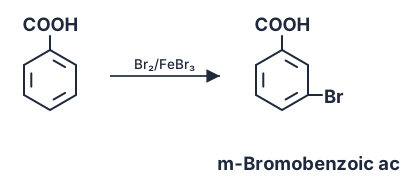
Drawn by us to help you understand the concept clearly, and verified to make sure it's accurate. For exams, practice from your textbook's own diagram.
Redrawn from the NCERT page with the structures, printed labels (COOH, Br) and reagent placement exactly as the textbook prints them. Every element of this display was checked against the printed page during the sweep's blind-judge verification pass, so what …
…