Chemistry · Ch 2 — Electrochemistry
Fuel Cells
Fuel Cells
Why fuel cells are needed
Ordinary thermal power plants are not a very efficient way to generate electricity, and they pollute heavily. They first burn a fossil fuel (coal, gas, or oil) to convert the heat of combustion into high-pressure steam, and that steam then drives a turbine to generate electricity. Every one of these energy conversions — chemical to heat, heat to steam pressure, pressure to mechanical rotation, and finally rotation to electricity — wastes energy along the way.
A galvanic cell, by contrast, converts chemical energy directly into electrical energy, which makes it inherently far more efficient. Building on this idea, it is possible to design galvanic cells in which the reactants are fed in continuously at the electrodes and the products are removed continuously from the electrolyte compartment, so the cell keeps generating current without needing to be replaced or recharged.
Fuel cell: a galvanic cell designed to convert the energy released by the combustion of a fuel — such as hydrogen, methane, or methanol — directly into electrical energy, instead of burning the fuel to release heat first.
The hydrogen–oxygen fuel cell
The most successful fuel cell built so far runs on the reaction between hydrogen and oxygen to form water. This cell supplied electrical power aboard the Apollo space missions — a use case where reliability and the useful by-product of pure water (condensed from the water vapour produced and added to the astronauts' drinking supply) both mattered.
Construction
- The two electrodes are made of porous carbon, which lets the gases diffuse into contact with the electrolyte while still conducting electrons.
- The electrodes are impregnated with a catalyst — finely divided platinum, palladium, or silver — to speed up the otherwise slow electrode reactions.
- The electrolyte is a concentrated aqueous solution of sodium hydroxide (NaOH) or potassium hydroxide (KOH).
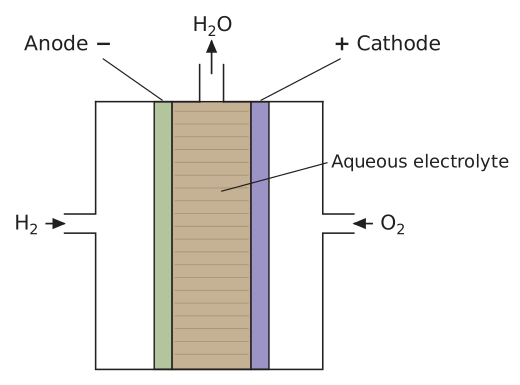
- Hydrogen gas (H₂) is bubbled continuously into the compartment holding the anode, and oxygen gas (O₂) is bubbled continuously into the compartment holding the cathode.
Drawn by us to help you understand the concept clearly, and verified to make sure it's accurate. For exams, practice from your textbook's own diagram.
The figure is a schematic of a hydrogen-oxygen fuel cell, drawn as three vertical blocks. On the left is a porous anode (marked –) with an inlet for hydrogen gas (). On the right is a porous cathode (marked +) with an inlet for oxygen gas (). Between them is the aqueous electrolyte (typically a concentrated solution of or ). At the top of the electrolyte, an outlet arrow is labelled , indicating that water is the product removed from the cell.
Physical idea: The fuel cell converts the chemical energy of a fuel (hydrogen) and an oxidant (oxygen) directly into electrical energy, without combustion. Hydrogen gas is fed to the anode, where it is oxidised, releasing electrons. These electrons travel through an external circuit to the cathode, where oxygen is reduced. The electrolyte allows ions to move between the electrodes to complete the circuit. The only by-product is water, making the fuel cell pollution-free.
Key reactions and formulas developed with this figure:
At the anode (oxidation):
At the cathode (reduction):
The overall cell reaction is obtained by multiplying the anode reaction by 2 and adding:
The standard cell potential for this reaction is:
…
Electrode reactions
Cathode (reduction):
Anode (oxidation):
Overall cell reaction:
Oxygen is reduced at the cathode, hydrogen is oxidised at the anode, and the hydroxide ions produced at the cathode are consumed back at the anode — so the electrolyte composition stays unchanged while water keeps forming as the actual product. As long as hydrogen and oxygen keep being fed in, the cell keeps producing current; it does not run down or need replacing the way an ordinary battery does.
Why fuel cells matter
Fuel cells convert chemical energy to electrical energy with an efficiency of about 70%, well above the roughly 40% efficiency of a typical thermal power plant.
Because the only product of the H₂–O₂ cell is water, fuel cells are essentially non-polluting.
…