Q.Haloalkanes react with KCN to form alkyl cyanides as main product while AgCN forms isocyanides as the chief product. Explain.
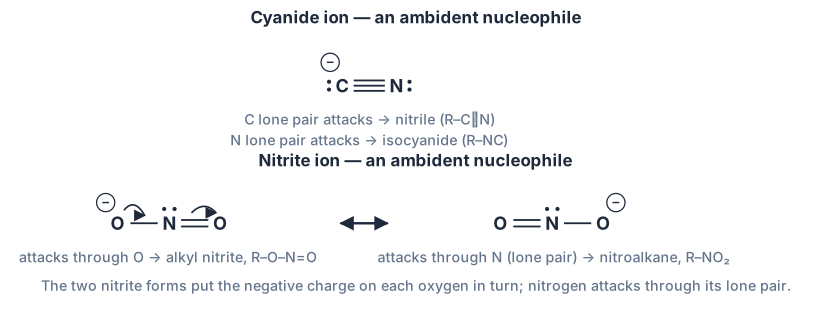
KCN is ionic, giving a free that attacks through its more nucleophilic CARBON end, forming an alkyl cyanide. AgCN is covalent, with silver bonded to the CARBON of the cyanide group () — that is exactly what leaves the nitrogen's lone pair exposed and free to act as the nucleophile instead, giving the isocyanide.
Why cyanide is ambident
The cyanide ion has lone-pair density on both its carbon and nitrogen ends, so it can attack an electrophile through either atom, giving different products: attack through carbon gives an alkyl cyanide (nitrile, ); attack through nitrogen gives an alkyl isocyanide (isonitrile, ).
KCN: free, ionic cyanide attacks through carbon
KCN dissociates completely into and free in solution. The carbon end of is more nucleophilic (larger, more polarisable, and it forms a stronger C–C bond with the alkyl carbon than the alternative C–N bond would), so attack happens at carbon, giving the nitrile as the major product:
AgCN: covalent, silver bonded to CARBON, leaving nitrogen free
AgCN is not a simple source of free — it is covalent, and the silver sits on the carbon end of the cyanide group: . With silver already occupying the carbon, that end is no longer available to act as a nucleophile — it is the nitrogen lone pair that is left exposed, and nitrogen is what attacks the alkyl halide's carbon. The product is the isocyanide, with silver halide as the byproduct:
A common mix-up is to think the metal in AgCN sits on nitrogen. It is the opposite: silver bonds to carbon, and it is precisely THAT occupation of the carbon end that forces the nitrogen end to be the one that attacks — not some separate "kinetic vs thermodynamic" argument.
Summary
| Reagent | Nature of CN | Silver/metal bonds to | Free end that attacks | Product |
|---|---|---|---|---|
| KCN | Free ion | — (no metal coordination) | Carbon (intrinsically more nucleophilic) | (nitrile) |
| AgCN | Covalent | Carbon | Nitrogen (freed up since carbon is occupied) | (isocyanide) |
KCN provides free , which attacks through its more nucleophilic carbon end to give alkyl cyanides (). AgCN is covalent with silver bonded to the carbon of the cyanide group, which leaves the nitrogen end free to attack instead, giving alkyl isocyanides ().
Unlock everything free for 14 days
- Full step-by-step solutions
- Concept-first explanations
- Methods, shortcuts & mistakes
- PYQ mapping + timed mock tests
Full access for 14 days. No credit card required.