Chemistry · Ch 1 — Solutions
Vapour Pressure of Liquid-Liquid Solutions
Vapour Pressure of Liquid-Liquid Solutions
Consider a binary solution of two volatile liquids, labelled component 1 and component 2. When this solution is kept in a closed vessel, both liquids evaporate. In time a dynamic equilibrium is set up between the liquid phase and the vapour phase above it.
At this equilibrium let:
- = total vapour pressure over the solution,
- = partial vapour pressures of components 1 and 2,
- = mole fractions of components 1 and 2 in the liquid.
The question is: how does each partial pressure depend on the composition of the liquid?
Raoult's law for volatile liquids
The French chemist François Marie Raoult (1886) answered this. Raoult's law states that for a solution of volatile liquids, the partial vapour pressure of each component is directly proportional to its mole fraction in the solution.
For component 1:
and
For component 2:
where
- = vapour pressure of pure component 1 (at that temperature),
- = vapour pressure of pure component 2 (at that temperature).
Each partial pressure grows linearly from zero (when that component is absent) up to the pure-liquid value (when it is the only component present).
Total vapour pressure
By Dalton's law of partial pressures, the total pressure over the solution is the sum of the partial pressures:
Substituting Raoult's law for each component:
Since the mole fractions add to one, . Replacing :
Expanding and grouping the terms gives the linear form:
What the linear form tells us
Three conclusions follow directly:
- The total vapour pressure can be expressed through the mole fraction of any one component.
- varies linearly with the mole fraction of component 2.
- Depending on the values of and , the total pressure rises or falls as increases — it falls with increasing when component 1 is the less volatile one.
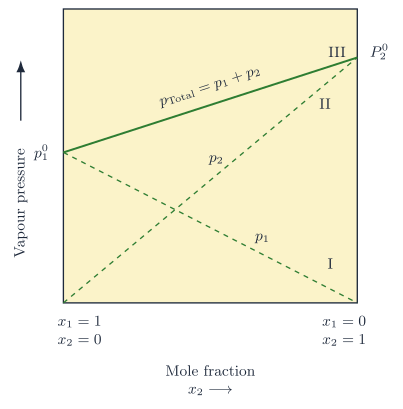
A plot of or against mole fraction is a straight line, and the plot of against is also a straight line. If component 1 is less volatile than component 2 (that is, ), then ranges between a minimum of (pure 1) and a maximum of (pure 2).
Drawn by us to help you understand the concept clearly, and verified to make sure it's accurate. For exams, practice from your textbook's own diagram.
What the Figure Shows
The plot has vapour pressure on the vertical axis and mole fraction on the horizontal axis. The horizontal axis runs from pure component 1 (mole fraction , ) on the left to pure component 2 (, ) on the right. At the left edge, the vapour pressure of pure component 1, , is marked; at the right edge, the vapour pressure of pure component 2, , is marked.
Three lines appear:
- Dashed line I (labelled ): starts at on the left and falls linearly to zero at the right. This shows that the partial pressure of component 1 is directly proportional to its mole fraction .
- Dashed line II (labelled ): starts at zero on the left and rises linearly to on the right. This shows that the partial pressure of component 2 is directly proportional to its mole fraction .
- Solid line III (labelled ): is a straight line joining on the left to on the right. It represents the sum of the two dashed lines at every composition.
The Physical Idea
The figure teaches Raoult's law for an ideal binary liquid solution: the partial vapour pressure of each volatile component in the solution is proportional to its mole fraction in the liquid phase. Because the total vapour pressure is the sum of the partial pressures, it also varies linearly with composition. The dashed lines show the individual contributions; the solid line shows the overall vapour pressure of the solution.
Key Formulas Developed from the Figure
For component 1:
where is the partial vapour pressure of component 1 above the solution, is the vapour pressure of pure component 1 at the same temperature, and is its mole fraction in the liquid.
For component 2:
with analogous meanings.
The total vapour pressure is:
…
Composition of the vapour phase
The vapour in equilibrium with the solution has its own composition, fixed by the partial pressures. If and are the mole fractions of components 1 and 2 in the vapour, then again by Dalton's law: …