Q.A man of height metres walks at a uniform speed of km/h away from a lamp post which is metres high. Find the rate at which the length of his shadow increases.
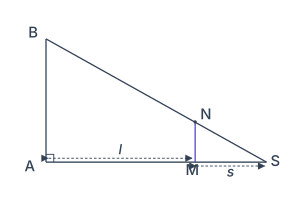
Using similar triangles, the shadow length and the man’s distance from the lamp post are related by . Differentiating with respect to time gives , so km/h. The shadow length increases at 2.5 km/h.
This is a classic related rates problem. The core idea: two quantities (the man’s distance from the lamp post and the length of his shadow) change together because they are linked by geometry. When you know how fast one changes, you can find how fast the other changes — by differentiating the geometric relationship.
The geometry here is driven by light travelling in straight lines. The lamp at the top of the post casts a ray that just grazes the man’s head and hits the ground at the tip of his shadow. That ray, the lamp post, and the ground form a large right triangle. The man’s body and his shadow form a smaller, similar right triangle inside it. Similar triangles give a clean linear relation — no squares, no trig — which makes the differentiation trivial.
Let’s set it up step by step.
-
Draw and label the figure.
Let be the foot of the lamp post, the lamp (so m). Let be the man’s feet, his head (so m). The point is the tip of his shadow on the ground.
The distance from the lamp post to the man is . The shadow length is .
The ray from through hits the ground at , so lies on .
-
Write the similarity relation.
Triangles and share the angle at and both have a right angle (at and respectively). So they are similar:
Here , and . Substituting:
which simplifies to
- Solve for the relation between and . Multiply through:
This is the key geometric link: the man’s distance from the post is always twice his shadow length.
The relation is independent of the actual numbers — it comes from the ratio of heights (6:2 = 3:1). If the lamp were 8 m and the man 2 m, you’d get . Always derive it fresh from the similar triangles.
- Differentiate with respect to time. Both and change as the man walks. Differentiate implicitly:
The man walks away at a uniform speed of km/h, so km/h (positive because increases).
- Solve for .
A common mistake is to think the shadow length increases at the same rate as the man’s speed. But the geometry shows the shadow grows at half that rate — because the man’s own height “shields” part of the ray. Always check the factor from similar triangles.
The units are consistent: km/h for speed, so the answer is in km/h. If the problem had asked in m/s, you’d convert: km/h m/s — but the given speed is in km/h, so the answer stays in km/h.
The length of his shadow increases at 2.5 km/h.
Unlock everything free for 14 days
- Full step-by-step solutions
- Concept-first explanations
- Methods, shortcuts & mistakes
- PYQ mapping + timed mock tests
Full access for 14 days. No credit card required.