Q.State Kirchhoff's laws for an electrical network. Use them with a neat circuit diagram to obtain the condition of balance for a Wheatstone's bridge. (2+1+4=7)
You're viewing a preview — the full solution, concept, methods & PYQ mapping are locked.
Start your 14-day free trial to unlock the full solution →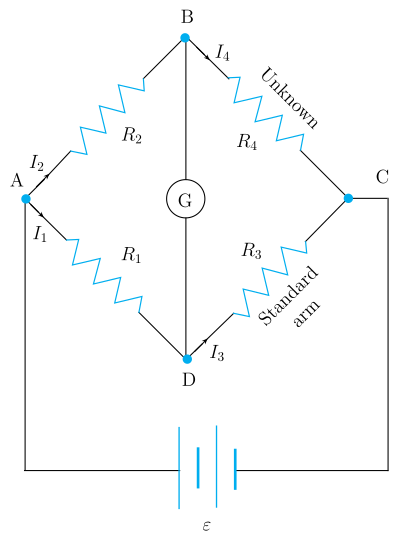
Kirchhoff's current law and voltage law, applied to the Wheatstone bridge network, give the balance condition P/Q = R/S, at which the galvanometer shows zero deflection.
Kirchhoff's First Law (Junction / Current Law): At any junction in an electrical network, the algebraic sum of currents meeting at that junction is zero, i.e. the total current entering a junction equals the total current leaving it. This follows from conservation of electric charge (charge cannot accumulate at a junction in steady state).
Kirchhoff's Second Law (Loop / Voltage Law): In any closed loop of an electrical network, the algebraic sum of the potential differences (IR products) across all elements, plus the algebraic sum of the emfs, in that loop is zero. This follows from conservation of energy (a charge returning to its starting point after going around a closed loop must have zero net change in potential).
Wheatstone bridge balance condition: Consider a Wheatstone bridge with four resistances P, Q, R, S forming a quadrilateral ABCD, a battery connected across A and C, and a galvanometer connected across B and D (the diagonal). Let be the currents through P, Q and through R, S, and the current through the galvanometer.
…
Unlock everything free for 14 days
- Full step-by-step solutions
- Concept-first explanations
- Methods, shortcuts & mistakes
- PYQ mapping + timed mock tests
Full access for 14 days. No credit card required.