Question of 67
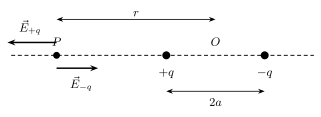
Q.What is an electric dipole? Derive expressions for the electric field due to a dipole at a point in
(a) end-on position and
(b) broad-side-on position. (1+3+3=7)
Odisha ChseOdisha CHSE +2 Science Board Exam 2024Subjective· 7mImportance★★★★★
0% · 0/67 Questions
You're viewing a preview — the full solution, concept, methods & PYQ mapping are locked.
Start your 14-day free trial to unlock the full solution →An electric dipole (charges +q, −q separated by 2a, moment p=q·2a) produces a field E = (1/4πε_0)(2p/r³) on its axis and E = (1/4πε_0)(p/r³) on its equatorial line, for r >> a.
An electric dipole consists of two equal and opposite point charges, +q and −q, separated by a small distance 2a. Its dipole moment is a vector p of magnitude p = q(2a), directed from the negative charge to the positive charge.
- Field at an axial (end-on) point: Consider a point P on the axis of the dipole, at distance r from its centre O, on the side of +q. The distance of P from +q is (r−a) and from −q is (r+a). Field due to +q at P (pointing away from +q, i.e. along the axis, away from the dipole): E_+ = (1/4πε_0) × q/(r−a)² Field due to −q at P (pointing towards −q, i.e. in the OPPOSITE direction along the axis): E_− = (1/4πε_0) × q/(r+a)² Since P is closer to +q, E_+ > E_−, and both fields lie along the same line (the axis), so the resultant is their difference, directed along the dipole moment: E_axial = (1/4πε_0) × q × [1/(r−a)² − 1/(r+a)²] = (1/4πε_0) × q × [(r+a)² − (r−a)²] / [(r−a)²(r+a)²] = (1/4πε_0) × q × (4ar) / (r²−a²)² = (1/4πε_0) × 2pr / (r²−a²)² [since p = 2qa] For a point far from the dipole (r >> a), a² can be neglected compared to r²: E_axial ≈ (1/4πε_0) × 2p/r³ directed along the dipole axis, in the same sense as p.
- Field at an equatorial (broad-side-on) point: Consider a point P on the perpendicular bisector of the dipole (equatorial line), at distance r from the centre O. The distance of P from EACH charge (+q and −q) is the same: s = √(r² + a²) So the magnitudes of the fields due to +q and −q at P are equal: E_+ = E_− = (1/4πε_0) × q/(r²+a²) …
Unlock everything free for 14 days
- Full step-by-step solutions
- Concept-first explanations
- Methods, shortcuts & mistakes
- PYQ mapping + timed mock tests
Full access for 14 days. No credit card required.