Q.Obtain the expression of electric field at any point on its axial line due to the electric dipole. Draw necessary diagram. OR Prove by Gauss's law that the value of electric field at any point due to a uniformly charged infinite plane sheet does not depend on the distance. Draw necessary diagram.
You're viewing a preview — the full solution, concept, methods & PYQ mapping are locked.
Start your 14-day free trial to unlock the full solution →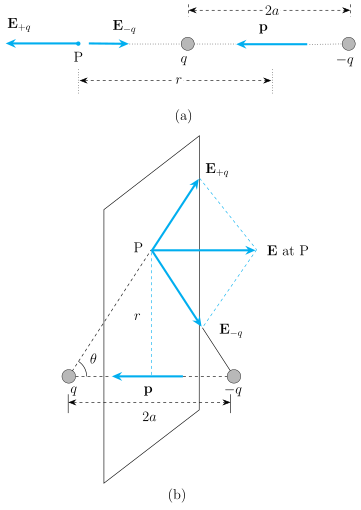
Adding the fields of the +q and -q charges (both along the axis) and simplifying for r much greater than the charge separation gives the standard axial dipole field E = 2kp/r^3.
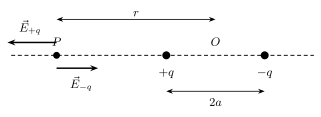
Consider an electric dipole consisting of charge -q at point A and +q at point B, separated by a distance 2a, with the dipole moment p = q(2a) directed from -q to +q. Let O be the midpoint of AB, and P be a point on the axial line (the line through A, O, B extended), at a distance r from O, with r >> a.
Distance of P from +q: (r - a); distance of P from -q: (r + a).
Field at P due to +q (pointing away from +q, i.e. along the axis toward the far side):
E+ = k q / (r - a)^2, directed from -q to +q side (away from the dipole)
Field at P due to -q (pointing toward -q, i.e. also along the axis, but in the same net direction since -q pulls P's test charge toward itself, which for a point beyond +q means direction is again away from -q, same line):
E- = k q / (r + a)^2, directed from P toward -q, i.e. opposite direction to E+ along the axis
Since E+ > E- (P is closer to +q), the net field E_axial = E+ - E-, directed along the dipole moment (from -q toward +q):
E_axial = k q [ 1/(r-a)^2 - 1/(r+a)^2 ]
= k q * [ (r+a)^2 - (r-a)^2 ] / [(r-a)^2 (r+a)^2] …
Unlock everything free for 14 days
- Full step-by-step solutions
- Concept-first explanations
- Methods, shortcuts & mistakes
- PYQ mapping + timed mock tests
Full access for 14 days. No credit card required.