Economics · Ch 14 — Employment: Growth, Informalisation and Other Issues
Informalisation of Indian Workforce
Informalisation of Indian Workforce
The deteriorating quality of employment
In the previous section we saw that the proportion of hired-work jobs — working for others — has been increasing. One of the objectives of development planning in India, since Independence, has been to provide decent livelihoods to its people; it was envisaged that the industrialisation strategy would draw surplus workers from agriculture into industry, with a better standard of living, as happened in developed countries. Yet even after 70 years of planned development, more than half of India's workforce still depends on farming as its main source of livelihood.
Economists argue that the quality of employment has actually been deteriorating over the years. Even after working for 10-20 years, why do some workers still get no maternity benefit, provident fund, gratuity or pension? Why does someone doing the same work in the private sector often earn a lower salary than a person in the public sector? Only a small section of India's workforce gets a regular income; the government protects their rights through labour laws, and this section of the workforce forms trade unions and bargains with employers for better wages and social security.
Formal and informal sectors
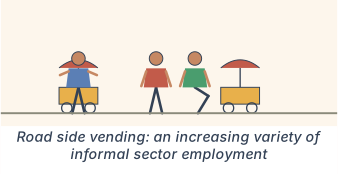
To identify who these protected workers are, the workforce is classified into two categories — formal and informal sectors, also called organised and unorganised sectors. All public sector establishments, and those private sector establishments that employ 10 hired workers or more, are called formal sector establishments, and those who work in them are formal sector workers. All other enterprises and the workers in them make up the informal sector — millions of farmers, agricultural labourers, owners of small enterprises and the people working in them, the self-employed who hire no one, and non-farm casual wage labourers (such as construction and headload workers) who work for more than one employer. This is only one way of classifying workers; there could be others — worth discussing in class.
Box 6.1: Formal Sector Employment
Information on formal sector employment is collected by the Union Ministry of Labour through employment exchanges across the country. In 2012, of about 30 million formal sector workers, about 18 million were employed by the public sector — the major formal sector employer. Men form the majority here too: women made up only about one-sixth of the formal sector workforce. Economists point out that the reform process initiated in the early 1990s is linked with a decline in the number of workers employed in the formal sector. What do you think explains this?
Drawn by us to help you understand the concept clearly, and verified to make sure it's accurate. For exams, practice from your NCERT textbook's own diagram.
Own-drawn recreation of NCERT Fig 6.4 (book p.104) — n …
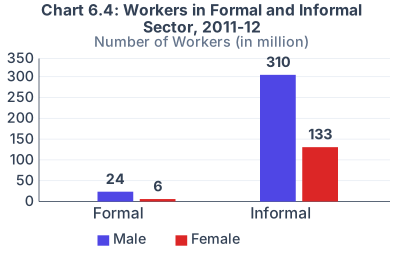
Those working in the formal sector enjoy social security benefits and earn more than those in the informal sector. Development planning had assumed that as the economy grew, more and more workers would become formal sector workers and the informal sector's share would shrink. But that is not what happened: in 2011-12, India had about 473 million workers in all, of whom only about 30 million — roughly six per cent (30/473 x 100) — were in the formal sector, leaving the remaining 94 per cent in the informal sector. In 2011-12, the year for which gender-wise data on formal-informal employment is available, about 20 per cent of formal sector workers and about 30 per cent of informal sector workers were women.
Drawn by us to help you understand the concept clearly, and verified to make sure it's accurate. For exams, practice from your NCERT textbook's own diagram.
Of India's roughly 473 million workers in 2011-12, only about 30 million (24m men + 6m women) were in the formal sector — about 6 per cent — against 443 million (310m men + 133m women) in the informal sector, about 94 per cent. Women make up a larger SHARE of the informal sector (133 of 443, about …
Box 6.2: Informalisation in Ahmedabad
Ahmedabad's prosperity rested on the produce of more than 60 textile mills employing about 150,000 workers, who over the course of the century had gained a degree of income security — secure jobs with a living wage, social security schemes covering their health and old age, and a strong trade union that both represented them in disputes and ran welfare activities for workers and their families. When textile mills across the country began closing in the early 1980s, Ahmedabad's own closures were long drawn out, spread over about ten years. Over this period, more than 80,000 permanent workers and more than 50,000 non-permanent workers lost their jobs and were driven into the informal sector. The city experienced an economic recession and public disturbances, including communal riots; a whole class of workers was thrown back from the middle class into poverty, and the fallout included widespread alcoholism, suicides, and children withdrawn from school and sent to work. (The book illustrates this with two captioned photographs: "Change in the balance of power in a house: an unemployed mill worker peeling garlic whereas his wife has a new job of beedi rolling.")
Source: Renana Jhabvala, Ratna M. Sudarshan and Jeemol Unni (Ed.), Informal Economy at Centre Stage: New Structures of Employment, Sage Publications, New Delhi, 2003, p.265. …