Economics · Ch 14 — Employment: Growth, Informalisation and Other Issues
Unemployment
Unemployment
How the unemployed look for work
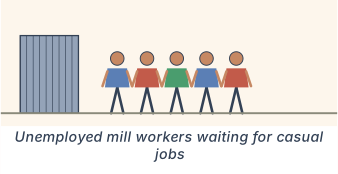
Drawn by us to help you understand the concept clearly, and verified to make sure it's accurate. For exams, practice from your NCERT textbook's own diagram.
Own-drawn recreation of NCERT Fig 6.5 (book p.106) — n …
People search for jobs in many ways — scanning newspapers, asking friends and relatives, standing at fixed points in cities hoping to be hired for a day's work, dropping bio-data at factories and offices, or registering at employment exchanges. In rural areas many simply stay home when there is no work.
Defining unemployment
The National Statistical Office (formerly the National Sample Survey Organisation) defines an unemployed person as one who, for lack of work, is not working but is either seeking work — through exchanges, intermediaries, friends, relatives or applications to employers — or is willing and available to work under prevailing conditions and wages. Economists also define an unemployed person as one unable to get even one hour of work in half a day. There are several sources of unemployment data: the Census of India, the National Statistical Office's Reports on the Employment and Unemployment Situation, the Annual Reports of the Periodic Labour Force Survey, and the Directorate General of Employment and Training's records of registrations at employment exchanges. These give different estimates but together describe who the unemployed are and the kinds of unemployment found in India.
Types of unemployment
- Open unemployment: the situation of people actively looking for work but unable to find any, as described above.
- Disguised unemployment: unemployment hidden within Indian farms, where more people work on a piece of land than are actually needed. For example, if a farmer with four acres needs only himself and two workers but instead employs five workers plus his wife and children, the extra hands are disguisedly unemployed. A study in the late 1950s found about one-third of India's agricultural workers to be disguisedly unemployed.
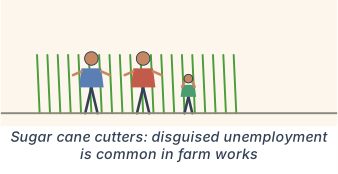
Drawn by us to help you understand the concept clearly, and verified to make sure it's accurate. For exams, practice from your NCERT textbook's own diagram.
Own-drawn recreation of NCERT Fig 6.6 (book p.107) — n …
- Seasonal unemployment: because farm work is seasonal and villages offer no work in the off-months, people migrate to towns for jobs and return home when the rainy season begins. The lack of year-round village employment produces this common form of unemployment. …