Computer Science · Ch 1 — Computer System
Evolution of Computer
Evolution of Computer
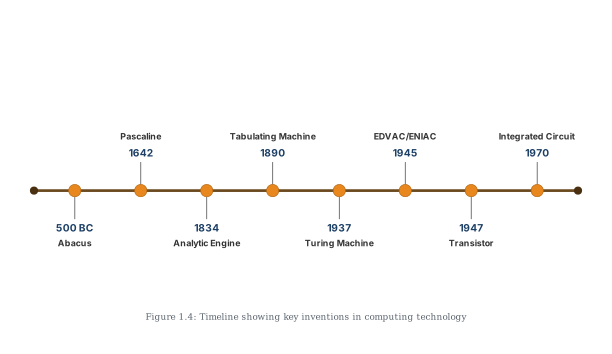
Computing devices have travelled, in a relatively short span of time, from simple mechanical calculators to today's powerful data processors. Figure 1.4 shows this journey as a timeline of key inventions; the story below follows that timeline in order.
The timeline of key inventions
-
Abacus (around 500 BC). Computing is attributed to the invention of the abacus almost 3000 years ago — a purely mechanical device capable of doing simple arithmetic calculations only.
-
Pascaline (1642). Blaize Pascal invented a mechanical calculator, known as the Pascal calculator or Pascaline. It could do addition and subtraction of two numbers directly, and performed multiplication and division through repeated addition and subtraction.
-
Analytical Engine (1834). Charles Babbage invented the analytical engine, a mechanical computing device capable of inputting, processing, storing and displaying output. Because it embodied these core functions, it is considered to form the basis of modern computers.
-
Tabulating Machine (1890). Herman Hollerith designed a tabulating machine for summarising data stored on punched cards. A punched card is a piece of stiff paper that stores digital data as holes at predefined positions. The tabulating machine is regarded as a step towards programming.
-
Turing Machine (1937). The Turing machine concept described a general-purpose programmable machine — one capable of solving any problem by executing a program stored on punched cards.
-
EDVAC / ENIAC (1945). John Von Neumann introduced the concept of the stored program computer, which could store both data and the program in memory. The EDVAC and then the ENIAC computers were developed on this concept.
-
Transistor (1947). Vacuum tubes were replaced by transistors, developed at Bell Labs using semiconductor materials — smaller, cooler and far more reliable.
-
Integrated Circuit (1970). An Integrated Circuit (IC) is a silicon chip containing an entire electronic circuit on a very small area. ICs drastically reduced the size of computers.
Von Neumann architecture
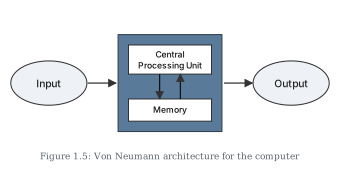
The Von Neumann architecture (Figure 1.5) is the design blueprint that stored-program computers follow. It consists of:
- a Central Processing Unit (CPU) for processing arithmetic and logical instructions,
- a memory that stores data and programs,
- input and output devices, and
- communication channels to send or receive data.
The ENIAC (Electronic Numerical Integrator and Computer) is the first binary programmable computer based on the Von Neumann architecture.
From chip integration to the microprocessor
- 1970s — LSI. Large Scale Integration (LSI) of electronic circuits made it possible to put a complete CPU on a single chip — this single-chip CPU is called a microprocessor.
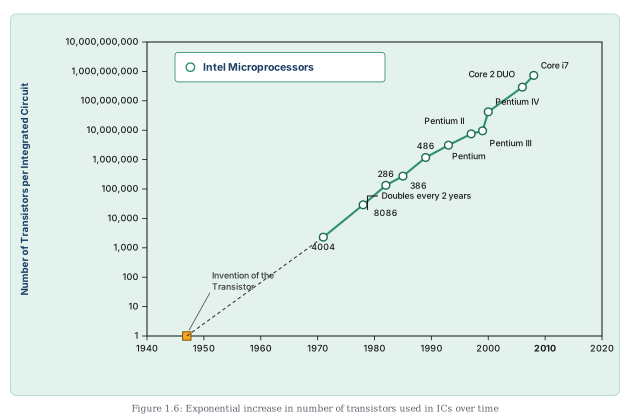
- Moore's Law (1965). Intel co-founder Gordon Moore predicted that the number of transistors on a chip would double every two years while costs would be halved — an exponential growth in chip capability. Figure 1.6 plots this: the transistor counts of Intel microprocessors from the 4004 onwards climb along a "doubles every 2 years" line.
- 1980s — VLSI. Very Large Scale Integration (VLSI) packed around 3 million components on a small chip, and processing power grew exponentially.
- SLSI. Further advances made it feasible to fabricate an even higher density of transistors and other components (approximately 10^6 components) on a single IC, termed Super Large Scale Integration (SLSI).
The personal computer era
- 1981 — IBM introduced its first personal computer (PC) for the home user.
- 1984 — Apple introduced the Macintosh.
- PC popularity surged when Graphical User Interface (GUI) based operating systems (from Microsoft and others) replaced command-line-only systems such as UNIX or DOS. …
Drawn by us to help you understand the concept clearly, and verified to make sure it's accurate. For exams, practice from your NCERT textbook's own diagram.
Figure 1.4 lays the whole history of computing along a single horizontal timeline. A long horizontal line spans the page, dotted with circular nodes — one for each landmark invention. Eight dated inventions are marked with bold year labels that alternate above and below the line; each carries the invention's name and a short explanatory note, joined to its node by a leader line.
Reading the timeline in date order:
- 500 BC — Abacus (below the line): computing is attributed to the abacus, invented almost 3000 years ago — a mechanical device capable only of simple arithmetic calculations.
- 1642 — Pascaline (above): Blaize Pascal's mechanical calculator, which added and subtracted two numbers directly, and multiplied and divided through repeated addition and subtraction.
- 1834 — Analytic Engine (below): Charles Babbage's mechanical computing device for inputting, processing, storing and displaying output — considered the basis of modern computers.
- 1890 — Tabulating Machine (above): Herman Hollerith's machine for summarising data stored on punched cards — a first step towards programming.
- 1937 — Turing Machine (below): the concept of a general-purpose programmable machine capable of solving any problem by executing a program stored on punched cards.
- 1945 — EDVAC/ENIAC (above): John Von Neumann's stored-program concept — storing data and program in memory — on which the EDVAC and then ENIAC computers were built.
- 1947 — Transistor (below): vacuum tubes replaced by transistors developed at Bell Labs using semiconductor materials.
- 1970 — Integrated Circuit (above): a silicon chip containing an entire electronic circuit on a very small area, drastically shrinking computers. …
Drawn by us to help you understand the concept clearly, and verified to make sure it's accurate. For exams, practice from your NCERT textbook's own diagram.
Figure 1.5 shows the Von Neumann architecture — the stored-program design on which the first binary programmable computer, the ENIAC, was built, and which modern computers still follow.
The diagram is deliberately spare. In the centre stands a solid block containing two boxes stacked vertically: the Central Processing Unit on top and the Memory below it. Between the two runs a pair of opposite vertical arrows — one pointing down, one pointing up — expressing the architecture's defining idea: the CPU and memory exchange traffic continuously in both directions, because memory holds both the data and the program, and the CPU must fetch instructions and data from it and write results back to it.
On the left, an oval labelled Input sends a single arrow into the central block; on the right, an oval labelled Output receives a single arrow out of it. Input and output flow one way each — data enters, results leave — while the CPU–memory link is the busy two-way channel in the middle. These connecting lines are the communication channels that the architecture prescribes for sending and receiving data. …
Drawn by us to help you understand the concept clearly, and verified to make sure it's accurate. For exams, practice from your NCERT textbook's own diagram.
Figure 1.6 is a line chart that turns Moore's Law into a picture. The vertical axis is labelled "Number of Transistors per Integrated Circuit" and uses a logarithmic scale — its tick labels climb by a factor of ten at each step, from 1 at the bottom through 10, 100, 1,000 and so on up to 10,000,000,000 (ten billion) at the top. The horizontal axis shows years from 1940 to 2020 in decade steps.
A legend at the top left identifies the plotted series as Intel Microprocessors. The data itself is a rising trend line running from lower-left to upper-right, studded with circular data points, each labelled with the processor it represents. In ascending order along the line: 4004, 8086, 286, 386, 486, Pentium, Pentium II, Pentium III, Pentium IV, Core 2 DUO, Core i7. (In the printed chart the 486 label appears doubled as "486486" — an artefact of overlapping labels, not a separate chip.) Near the x-axis around 1947, a separate square marker annotated "Invention of the Transistor" marks the starting point of the whole story, joined to the first microprocessor point (the 4004) by a dashed line. A bracket annotation along the trend line reads "Doubles every 2 years." …