Physical Education · Ch 7 — Fundamentals of Anatomy and Physiology in Sports
Classification of Bones
Classification of Bones
Bones can be classified in two different ways: by the kind of bone tissue they are made of, and by their shape and size.
Classification based on bone tissue
There are two basic types of bone tissue:
| Type of bone tissue | What it is like |
|---|---|
| Compact bone | Dense and smooth. |
| Spongy bone | Made up of small, needle-like pieces of bone. |
Classification based on shape and size
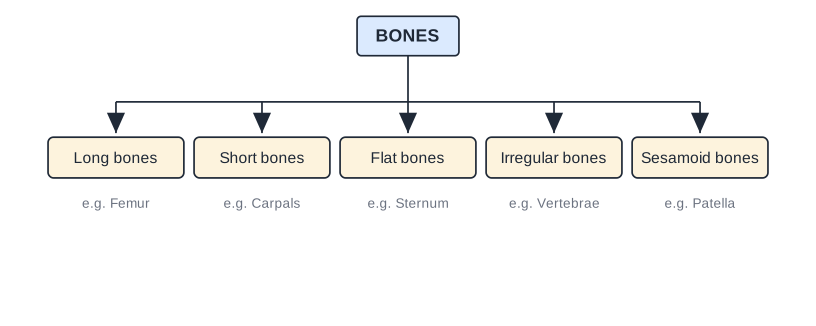
By shape, bones fall into five classes.
Drawn by us to help you understand the concept clearly, and verified to make sure it's accurate. For exams, practice from your NCERT textbook's own diagram.
A simple classification tree: a single box labelled BONES at the top, with five branches leading down to five labelled boxes - Long bones, Short bones, Flat bones, Irregular bones and Sesamoid bones. Use the tree as a quick recall aid: each branch corresponds to one of the five shape-based classes described in the text above it, and each shape is matched to a function - long bones act as levers, short bones absorb shock and glide, flat bones protect organs, irregular bones …
1. Long bones
Long bones are hard, dense bones that give the body strength, structure and mobility. They are named for their shape, not their size: they are cylindrical and have more length than width. A long bone is covered by a fibrous sheet except where it meets another bone, where it is covered by a thin sheet of cartilage. Long bones contain both yellow and red bone marrow, which produce blood cells. Examples: the upper and lower arm (humerus, radius, ulna), the thigh and leg (femur, tibia, fibula), and the metacarpals and phalanges of the hands and feet. They act as the body's levers.
2. Short bones
Short bones have a cube-like shape with roughly equal length, width and thickness. A short bone is made of central spongy bone covered by a thin layer of compact bone. Their motion is limited, and they glide on one another. Examples: the carpals of the wrist and the tarsals of the ankle.
3. Flat bones
Flat bones are thin and usually curved. They are made of a central layer of spongy bone between two outer layers of compact bone. They form a bony cage that helps protect the soft internal organs. Examples: the cranial bones, the ribs, the sternum, the scapula and the hip bone.