Biology · Ch 3 — Plant Kingdom
Algae
Algae
Algae are the simplest members of the plant kingdom. They carry chlorophyll, so they make their own food (they are autotrophic), yet their body stays simple and undifferentiated — it is a thallus, meaning it is not divided into true roots, stems and leaves. Most algae live in water, both fresh water and the sea, though they are far from being confined to it.
Where algae live
Water is the usual home, but algae turn up in many other damp places as well:
- On moist stones, in soils and on wood.
- In partnership with fungi, forming the composite organisms called lichens.
- In association with animals — for instance, growing on the fur of a sloth bear.
Range of form and size
The body of an alga varies enormously from one kind to another. Some are colonial, such as Volvox, where many cells live together as a coordinated ball. Others are filamentous, growing as long threads of cells, as in Ulothrix and Spirogyra. At the other extreme, some marine algae — the kelps — build very large, massive plant bodies.
How algae reproduce
Algae multiply in three broad ways: vegetative, asexual and sexual.
- Vegetative reproduction happens by fragmentation. The thallus simply breaks into pieces, and every fragment grows into a fresh, complete thallus.
- Asexual reproduction works through spores of various kinds. The commonest of these is the zoospore. Zoospores carry flagella, so they can swim (they are motile), and when one settles and germinates it gives rise to a new plant.
- Sexual reproduction takes place when two gametes fuse. The nature of the fusing gametes lets us recognise three patterns:
- Isogamous — the two gametes look alike and are of the same size. They may both be flagellated and motile, as in Ulothrix, or both be non-flagellated and non-motile, as in Spirogyra.
- Anisogamous — the two gametes are similar in kind but differ in size, as seen in species of Eudorina.
- Oogamous — fusion occurs between one large, non-motile (static) female gamete and a much smaller, motile male gamete, as in Volvox and Fucus.
Why algae matter
Algae are useful to people, and to life on Earth, in several important ways.
- Through photosynthesis they carry out at least half of all the carbon dioxide fixation that happens on the planet.
- Because they photosynthesise, they raise the amount of dissolved oxygen in the water around them.
- They are prime primary producers, building the energy-rich compounds that support the food cycles of every aquatic animal.
- Many are eaten as food. Several species of Porphyra, Laminaria and Sargassum are among about seventy species of marine algae used as human food. …
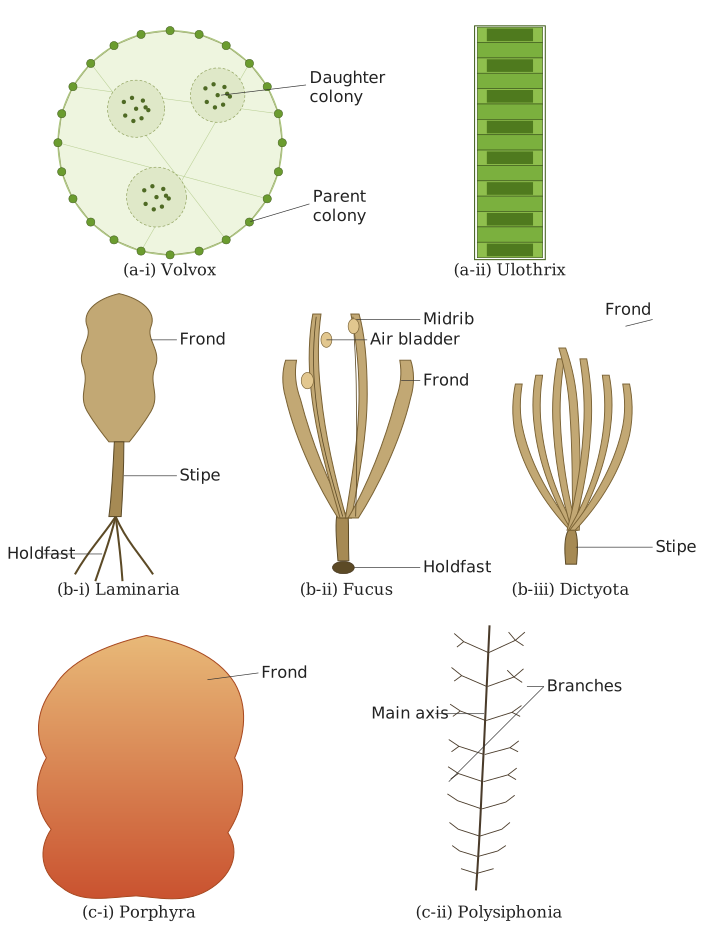
Drawn by us to help you understand the concept clearly, and verified to make sure it's accurate. For exams, practice from your NCERT textbook's own diagram.
This plate shows representative members of the three main classes of algae, illustrating how varied their body forms are. From the green algae (Chlorophyceae): Volvox (a-i) is drawn as a hollow sphere built from many small cells linked in a net-like pattern, and within it several smaller daughter colonies can be seen forming inside the parent colony — a colonial alga literally budding off new colonies before they are released, which is the reason Volvox is used to illustrate colonial organisation and reproduction. Ulothrix (a-ii) is shown as a simple, unbranched filament of cells in a row. From the brown algae (Phaeophyceae): Laminaria (b-i) is anchored by a holdfast, carries a short stalk-like stipe, and spreads into a broad, leaf-like frond; Fucus (b-ii) is similarly organised into holdfast, frond and a midrib running down it, and also bears rounded air bladders that help the frond float; Dictyota (b-iii) is a repeatedly forking, fan-like frond attached by a stipe. From the red algae (Rhodophyceae): Porphyra (c-i) is a broad, flat, sheet-like frond, while Polysiphonia (c-ii) — not Gracilaria — is a finely and repeatedly branched, feathery thallus with a distinct main axis giving off many side branches. Together the figure show …