Chemistry · Ch 6 — Equilibrium
Effect of Concentration Change
Effect of Concentration Change
The Core Idea: Disturbing Equilibrium by Changing Concentration
When a chemical system is at equilibrium, the forward and reverse reaction rates are equal, and the concentrations of reactants and products are constant. If you disturb this balance by adding or removing a reactant or product, the system will respond to counteract that change. This is a direct application of Le Chatelier’s principle.
The principle predicts two clear outcomes for concentration changes:
- Adding a substance: The system will shift in the direction that consumes the added substance.
- Removing a substance: The system will shift in the direction that replenishes the removed substance.
In other words, the composition of the equilibrium mixture changes to minimise the effect of the concentration change you made.
How the Reaction Quotient Explains the Shift
The reaction quotient, , is the tool that lets us see why the shift happens. For the reaction:
The equilibrium constant is .
At equilibrium, .
Scenario: Adding to the equilibrium mixture.
- The Disturbance: You suddenly increase .
- The Immediate Effect: The denominator of the expression becomes larger. This makes the value of smaller than .
- The System's Response: The system is now in a state where . To reach equilibrium again, the reaction must produce more products and consume reactants. This means the net reaction proceeds in the forward direction (towards products).
- The New Equilibrium: The forward reaction consumes some of the added and some to produce more . The new equilibrium concentrations will be such that again. The final concentration of will be higher than it was originally, but lower than it was immediately after the addition.
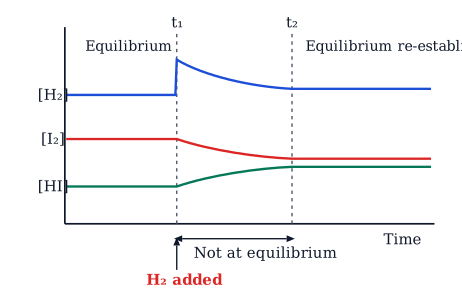
Drawn by us to help you understand the concept clearly, and verified to make sure it's accurate. For exams, practice from your NCERT textbook's own diagram.
What the Graph Shows
The figure is a concentration-versus-time plot for the reaction . The vertical axis is concentration (in mol/L), and the horizontal axis is time. Before the disturbance, all three species have flat, horizontal lines — the system is at equilibrium, with constant concentrations of , , and .
At a marked time , a sudden vertical spike appears on the curve: this is the instant when extra hydrogen gas is added to the equilibrium mixture. The concentration of jumps sharply upward, while and remain momentarily unchanged — the addition is so fast that the other species haven't had time to react yet.
Between and a later time , the system is labelled "not at equilibrium." During this interval, the curve falls, the curve falls, and the curve rises. All three curves are sloping, not flat. This is the period during which the forward reaction is consuming the added hydrogen and also using up iodine, while producing more hydrogen iodide.
After , all three curves become flat again — a new equilibrium has been reached. Compared to the original equilibrium, the new flat lines show a higher concentration of , a lower concentration of , and a concentration of that is higher than the original but lower than the spike value immediately after addition.
The key visual takeaway: the system does not return to the original equilibrium. It settles at a different equilibrium, shifted toward products, exactly as Le Chatelier's principle predicts.
The Physical Idea
The graph illustrates Le Chatelier's principle for a concentration change: when you add a reactant to a system at equilibrium, the system responds by consuming some of that added reactant, shifting the net reaction in the direction that uses it up. Here, adding pushes the equilibrium to the right, producing more .
But the graph also teaches something subtler. The new equilibrium concentration of is not as low as the original — it remains higher than before the addition. The system does not "undo" the addition completely; it only partially counteracts it. This is the meaning of the textbook's statement: "the concentration of the reactant/product should be less than what it was after the addition but more than what it was in the original mixture."
The Formula That Explains the Graph
The textbook uses the reaction quotient to explain why the system moves forward after the addition. For this reaction:
At the original equilibrium, . When is added, the denominator increases sharply, so becomes smaller than :
The system is no longer at equilibrium. To restore , the numerator must increase and/or the denominator must decrease. The only way this happens is for the forward reaction to proceed — consuming and while producing . That is exactly what the sloping curves between and represent.
When , the net reaction proceeds forward until rises back to . …
The same logic applies to removing a product. If you remove , the numerator of decreases, making . The system responds by shifting forward to produce more .
A Powerful Commercial Application: Removing a Product
The principle of shifting equilibrium by removing a product is a cornerstone of industrial chemistry. If a reaction produces a gas or a volatile substance, continuously removing that substance from the reaction mixture keeps perpetually less than . This drives the reaction to completion, maximising the yield of the desired product.
Two classic examples from the textbook:
- Manufacture of Ammonia (Haber Process): In the reaction , ammonia is a gas. It is continuously liquefied and removed from the reaction mixture. This shifts the equilibrium to the right, producing more ammonia.
- Production of Calcium Oxide (Lime): In the thermal decomposition of limestone, , carbon dioxide gas is constantly removed from the kiln. This drives the reaction forward, ensuring the complete conversion of to .
The continuous removal of a product maintains at a value less than , forcing the reaction to keep moving in the forward direction.
A Visual Demonstration: The Iron(III) Thiocyanate Equilibrium
This is a classic experiment that lets you see Le Chatelier's principle in action. The reaction is:
(yellow) (colourless) (deep red)
When you mix a solution of iron(III) nitrate () with a solution of potassium thiocyanate (), a deep red colour appears due to the formation of the complex ion . The intensity of this red colour is directly proportional to the concentration of the complex. Once the colour intensity becomes constant, the system is at equilibrium.
You can now shift this equilibrium in either direction by changing the concentration of a reactant or product.
Shifting the Equilibrium to the Left (Reverse Direction)
You can shift the equilibrium to the left by removing one of the reactants. This is done by adding a reagent that reacts with and "ties up" either or ions.
-
Removing : Adding oxalic acid () causes it to react with ions to form a very stable complex ion, . This drastically reduces the concentration of free .
- The Disturbance: decreases.
- The Response: According to Le Chatelier's principle, the system tries to replenish the lost . It does this by dissociating some of the complex. The equilibrium shifts to the left.
- The Observable Effect: Because the concentration of the red decreases, the intensity of the red colour fades.
-
Removing : Adding a solution of mercury(II) chloride () causes ions to react with ions to form a stable complex, . This removes free from the solution.
- The Disturbance: decreases. …