Mathematics · Ch 10 — Conic Sections
Latus Rectum
Latus Rectum
Latus Rectum of an Ellipse
The latus rectum is a line segment that passes through a focus of the ellipse and is perpendicular to the major axis. Its endpoints lie on the ellipse itself. For an ellipse with its major axis along the x-axis, there are two such segments — one through each focus — and they are equal in length.
Finding the Length of the Latus Rectum
Consider the ellipse , where . The foci are at , and we know , where is the eccentricity.
Take the focus at . Let be the upper endpoint of the latus rectum through . Since the latus rectum is perpendicular to the major axis (the x-axis), the line through is vertical. So the x-coordinate of is , and let its y-coordinate be . Thus .
Because lies on the ellipse, its coordinates must satisfy the ellipse equation:
Simplify the first term:
Rearrange to solve for :
Now recall the relation between , , and for an ellipse. From and , we have:
Therefore:
Substitute this into the expression for :
Taking the positive square root (since is a length):
This is the distance from the focus to the upper endpoint of the latus rectum. The ellipse is symmetric about the x-axis, so the lower endpoint is at . The entire segment has length .
The same length holds for the latus rectum through the other focus by symmetry. …
Definition.
The latus rectum of an ellipse is a line segment that passes through one of the foci, lies perpendicular to the major axis, and has its endpoints on the ellipse.
Since an ellipse has two foci, it has two such segments — one through each focus. Both are identical in length.
Intuition.
Think of the latus rectum as the "vertical slice" through a focus. If you draw the major axis horizontally, then at each focus you draw a vertical line up and down until it meets the ellipse; the segment you get is the latus rectum. It tells you how "wide" the ellipse is at the level of the foci.
Length.
For the standard ellipse (major axis along -axis), the length of the latus rectum is .
Tiny example.
Take the ellipse . Here , . …
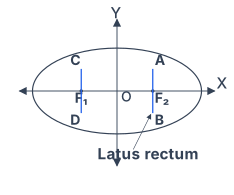
Drawn by us to help you understand the concept clearly, and verified to make sure it's accurate. For exams, practice from your NCERT textbook's own diagram.
What Fig. 10.26 Shows
The figure presents a standard horizontal ellipse centred at the origin, with the -axis as the major axis and the -axis as the minor axis. Two foci, labelled and , are marked on the -axis symmetrically about the centre. Through each focus, a vertical line segment is drawn perpendicular to the major axis, with its endpoints lying on the ellipse. These are the two latus rectum chords.
The chord through has endpoints labelled (above the -axis) and (below it). Similarly, the chord through has endpoints and . A label reading "Latus rectum" points to one of these chords. The entire diagram is set on a standard Cartesian coordinate grid, with the ellipse symmetric about both axes.
The Physical Idea
The latus rectum is a special chord of the ellipse that passes through a focus and is perpendicular to the major axis. It is not an arbitrary chord — its length is fixed for a given ellipse and turns out to be a simple expression involving the semi-major axis and the semi-minor axis . This length appears repeatedly in problems involving ellipses, from finding coordinates of points on the ellipse to calculating areas and in later physics applications like orbital mechanics.
The Key Formula
The textbook derives the length of the latus rectum by placing the focus at , where (with the eccentricity). Let the half-length of the latus rectum be , so that point has coordinates . Since lies on the ellipse, its coordinates satisfy the ellipse equation:
Substituting and :
Using and , this simplifies to:
Hence . The full latus rectum is twice this (since the chord extends both above and below the -axis), giving:
Here is the semi-major axis (half the length of the major axis), and is the semi-minor axis (half the length of the minor axis). For a vertical ellipse (major axis along ), the same formula holds, with still denoting the semi-major axis.
A common mistake is to use as the semi-major axis when the ellipse is vertical. Always identify which axis is longer — that axis gives , regardless of whether it is horizontal or vertical. The latus rectum formula uses as the semi-major axis.