Physics · Ch 3 — Motion in a Plane
Multiplication of Vectors by Real Numbers
Multiplication of Vectors by Real Numbers
Multiplying a Vector by a Real Number
When you multiply a vector by a real number (a scalar), you are scaling it. The result is a new vector whose magnitude is the original magnitude multiplied by the absolute value of that number. The direction of the new vector depends on the sign of the number.
If is any vector and is a real number, then the product is defined as follows:
- Magnitude:
- Direction: If , points in the same direction as . If , points in the opposite direction to .
For example, is a vector twice as long as and pointing the same way. The vector is half the length of and points exactly opposite to it. Multiplying by zero gives the zero vector: .
This operation is called scalar multiplication. The real number is often called a scalar in this context, to distinguish it from the vector quantity it multiplies.
Properties of Scalar Multiplication
Scalar multiplication obeys several important algebraic properties. These are essential for manipulating vector expressions in physics, just as the properties of ordinary multiplication are essential in algebra.
Let and be any two vectors, and let and be any two real numbers (scalars). The following properties hold:
(I) Commutative Property (for scalar multiplication with a vector):
This is a trivial property because multiplication of a scalar and a vector is defined as the scalar times the vector. The order does not matter.
(II) Associative Property (for multiplication by two scalars):
This means you can first scale the vector by and then by , or you can multiply the scalars first and then scale the vector once. The result is the same.
›Proof
Let be a vector. The vector has magnitude and direction same as if , opposite if .
Now, has magnitude .
Its direction is the same as if , opposite if . This is equivalent to the direction of scaled by the product .
On the other hand, has magnitude and direction same as if , opposite if .
Since the magnitude and direction match in both cases, .
(III) Distributive Property (over scalar addition):
This property tells us that adding two scalars and then multiplying the vector is the same as multiplying the vector by each scalar separately and then adding the resulting vectors.
›Proof
Let be a vector. Consider the vector . Its magnitude is .
The vector is the sum of two vectors. If and have the same sign, both and point in the same direction (same as if both positive, opposite if both negative). Their sum then has magnitude and points in that same direction. If and have opposite signs, the two vectors and point in opposite directions. Their sum then has magnitude and points in the direction of the larger magnitude. In all cases, the magnitude and direction of match those of , so the equality holds.
(IV) Distributive Property (over vector addition):
…
Drawn by us to help you understand the concept clearly, and verified to make sure it's accurate. For exams, practice from your NCERT textbook's own diagram.
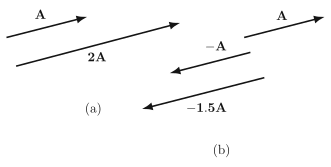
The figure has two panels, (a) and (b), and its purpose is to show you, at a glance, what it means to multiply a vector by a real number — a positive number, a negative number, and a number whose magnitude is not 1.
In panel (a), you see two arrows. The first is a short arrow labelled A. The second is an arrow exactly twice as long, pointing in the same direction, labelled 2A. That is the entire content of the panel. There are no axes, no grid, no coordinates — just two vectors drawn side by side for comparison. The physical idea is straightforward: multiplying a vector by a positive scalar changes only its magnitude (its length), not its direction. The number 2 tells you the new vector is twice as long as the original. If the scalar were 0.5, the arrow would be half as long; if it were 3.14, it would be 3.14 times as long. The direction stays identical.
Panel (b) shows three vectors. One arrow points to the right and is labelled A. A second arrow points to the left, is the same length as A, and is labelled –A. A third arrow also points to the left, is one-and-a-half times as long as A, and is labelled –1.5A. Again, no axes — just arrows. The key lesson here is that multiplying by a negative real number reverses the direction. The vector –A has the same magnitude as A but points exactly opposite. The vector –1.5A is both reversed in direction and 1.5 times longer. So the sign of the scalar controls the direction (positive = same, negative = opposite), while the absolute value of the scalar controls the magnitude.
A common mistake is to think that –A is "smaller" than A because of the minus sign. The minus sign has nothing to do with size — it only flips the arrow. The magnitude of –A is exactly the same as the magnitude of A.
The textbook uses this figure to introduce the general rule for multiplication of a vector by a real number. If is any vector and is a real number, then the product is a vector whose magnitude is times the magnitude of :
and whose direction is:
- the same as if ,
- opposite to if .
If , the result is the zero vector (a vector of zero length, with no defined direction). This single rule covers everything the figure shows: in panel (a), (positive, so same direction, double length); in panel (b), (negative, so opposite direction, same length) and (negative, so opposite direction, 1.5 times the length). …